Saber vs conocer: Spanish examples and ten exercises with answers
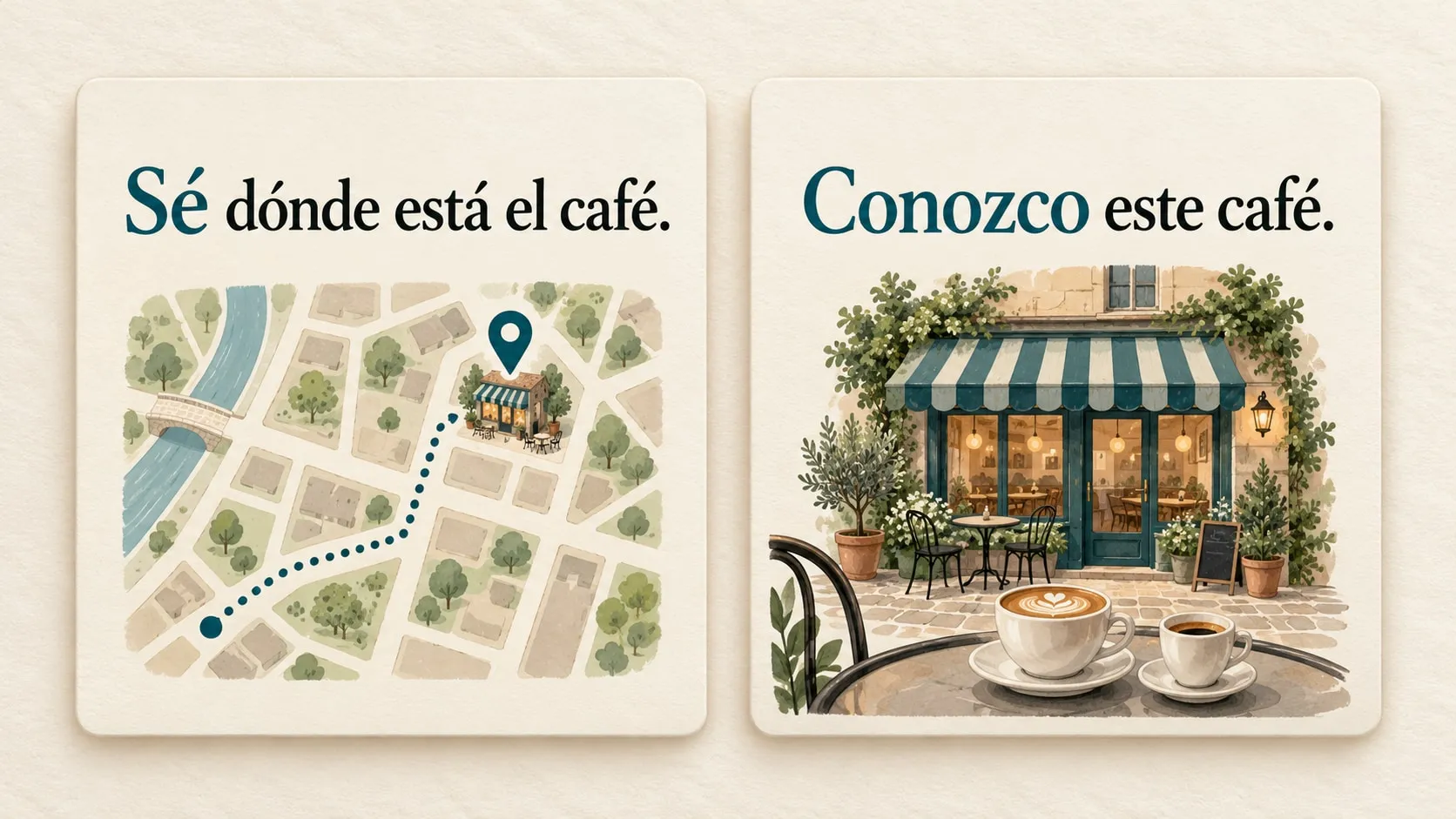
You know a café, and you know where it is. English uses the same verb, but Spanish makes a useful distinction: Conozco este café and Sé dónde está el café. The place does not determine the verb; the kind of knowledge does.
Start with saber for information and learned skills, and conocer for familiarity with people, places or things. These sentence pairs and ten exercises will help you choose in the present tense.
A quick choice: information, skill or familiarity?
| What do you mean? | Pattern | Example |
|---|---|---|
| Knowing information | saber + information or a clause | Sé la respuesta. – I know the answer. |
| Knowing where, when or whether | saber + question word or si | ¿Sabes cuándo empieza el curso? – Do you know when the course starts? |
| Knowing how to do something | saber + infinitive | Sé nadar. – I can swim. |
| Knowing a person | conocer a + person | Conozco a Lucía. – I know Lucía. |
| Being familiar with a place or work | conocer + noun | Conocemos este barrio. – We know this neighbourhood. |
Treat this as a guide to common meanings, not a rule that saber must come before another verb. Both Sé la respuesta and Sé que tienes razón – “I know you’re right” – are correct.
Present forms: remember sé and conozco
| Person | saber | conocer |
|---|---|---|
| yo | sé | conozco |
| tú | sabes | conoces |
| él / ella / usted | sabe | conoce |
| nosotros / nosotras | sabemos | conocemos |
| vosotros / vosotras | sabéis | conocéis |
| ellos / ellas / ustedes | saben | conocen |
Pay particular attention to yo sé, with an accent, and yo conozco, with -zc-. Vosotros is the familiar plural “you” in much of Spain. In Latin America, use ustedes with saben/conocen for plural address.
Saber: information and learned skills
When you can supply an answer, saber is often the right choice:
- Sé dónde vive Marta. – I know where Marta lives.
- No sabemos si la tienda está abierta. – We don’t know whether the shop is open.
- ¿Sabes su número de teléfono? – Do you know her/his phone number?
A phone number is a piece of information you can recall. Don’t choose conocer simply because the English sentence contains “know”: ask what kind of knowing the whole sentence expresses.
For a learned skill, put the infinitive directly after saber:
- Mi hermano sabe cocinar. – My brother knows how to cook.
- No sé conducir. – I don’t know how to drive.
There is no a or de between the verbs: sé nadar, not sé a nadar. This describes knowing how to do something, rather than whether circumstances allow you to do it right now.
Conocer: familiarity with people, places and works
Use conocer when someone or something is familiar to you:
- ¿Conoces a mi profesora? – Do you know my teacher?
- Conozco bien Valencia. – I know Valencia well.
- No conozco esta canción. – I don’t know this song.
With a specific person, include the personal a: Conozco a Lucía. Here it marks the person as a direct object. Don’t add it before the café or city: Conozco este café, Conozco Valencia.
Familiarity need not mean a face-to-face meeting. You can know a song, a theory or a book. The useful question is whether you mean familiarity with something or a specific fact about it.
One café, two different statements
Imagine choosing somewhere to meet:
— ¿Conoces este café? – Do you know this café? — No, pero sé dónde está. – No, but I know where it is.
You can know the location without being familiar with the café. The reverse is possible too:
Conozco este café, pero no sé a qué hora cierra. I know this café, but I don’t know what time it closes.
Avoid learning “a place means conocer”. Compare the intended message: familiarity with the café versus information about its location or opening hours.
Three mistakes to watch for
- Translating every “know” the same way. Knowing an answer and knowing a neighbour are different meanings.
- Dropping personal a. Use Conozco a Elena for “I know Elena”.
- Using conocer before an action infinitive. A learned skill takes saber: Sabemos bailar, not Conocemos bailar.
In the past, supe can mean “I found out”, and conocí a alguien can mean “I met someone”. For that change of viewpoint, see Spanish preterite vs imperfect. The exercises here stay in the present.
Ten exercises: decide before checking
For 1–8, fill the gap with the appropriate present form of saber or conocer. Use the meaning given in brackets.
- Yo ___ dónde está la biblioteca. (I know its location.)
- ¿Tú ___ a nuestra nueva vecina? (Are you acquainted with her?)
- Mi hermana ___ nadar. (She has learned the skill.)
- Nosotros no ___ este restaurante. (We aren’t familiar with it.)
- ¿Ustedes ___ si el museo abre hoy? (Do you have this information?)
- Yo ___ bien a Pablo. (We know each other well.)
- Ellas ___ la respuesta. (They can supply the information.)
- ¿Tú ___ esta canción? (Is the song familiar to you?)
- Correct: Yo sabo cocinar.
- Correct: Conozco Lucía. The speaker is personally acquainted with Lucía.
Answers explained
- sé – information about a location; irregular yo form with an accent.
- conoces – familiarity with a person; a is already before nuestra nueva vecina.
- sabe – a learned skill followed by the infinitive nadar.
- conocemos – familiarity with a restaurant, rather than one fact about it.
- saben – si introduces the information being asked about; ustedes takes this plural form.
- conozco – personal acquaintance; the yo form has -zc-.
- saben – la respuesta is information; saber can come before a noun.
- conoces – familiarity with a song.
- Yo sé cocinar. – Not sabo; the infinitive follows sé directly.
- Conozco a Lucía. – Include personal a before the name.
Turn the gaps into your own sentences
Make three statements: something you know, something you know how to do and a place you are familiar with. For example: Sé dónde está la estación. Sé cocinar. Conozco este barrio. Then hide the Spanish and rebuild the sentences from their meanings.
In Lingo Phrase Cards, you can choose an offered language direction and a suitable set. Prepared target-language phrases include IPA and audio. In regular study, answer before turning the card over; your rating affects its box and due date. Free pool, box and error-card practice provides extra review without changing card progress. Certain categorised sets require a licence.
To continue practising Spanish through complete phrases, visit the Lingo product page and explore the available language directions and sets.
Sources and further reading
- RAE / ASALE: saber: definitions and conjugation, conocer: definitions and conjugation.
- SpanishDictionary.com: Saber vs. Conocer.
- Lingolia: German-language comparison of conocer and saber.