Spanish preterite or imperfect? Choose the viewpoint for your story
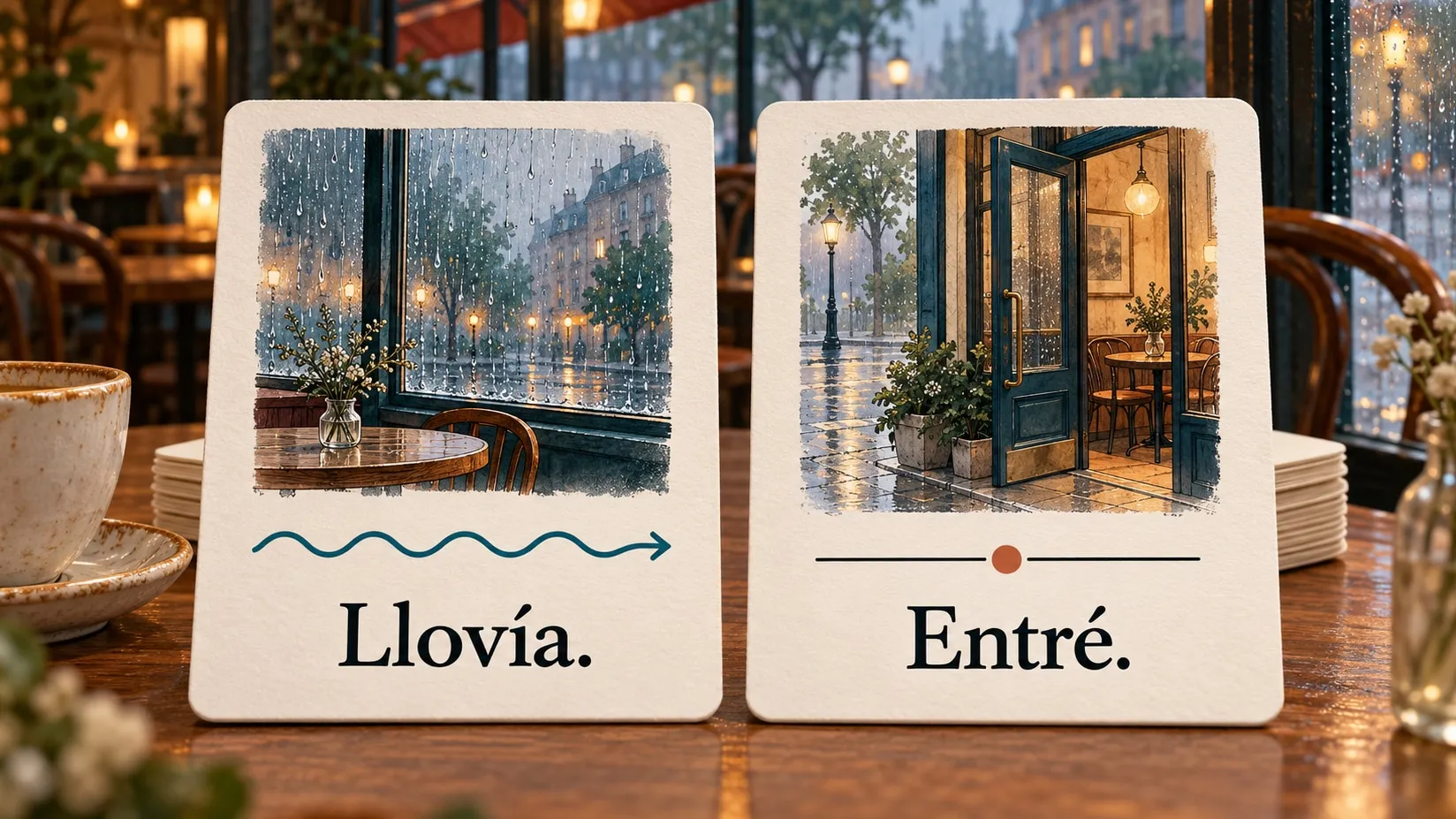
Llovía cuando entré en el café. — It was raining when I went into the café. Why llovía in the imperfect but entré in the preterite, even though both can refer to yesterday? One describes what was going on; the other tells us what happened.
To choose between the Spanish preterite and imperfect, think about viewpoint rather than simply “short versus long”. A short café scene will show you the contrast, followed by six exercises with explanations.
The difference at a glance
The preterite, called pretérito indefinido or pretérito perfecto simple in Spanish, presents a past situation as a bounded whole. The imperfect, or pretérito imperfecto, looks inside a state, habit or ongoing activity without foregrounding its boundaries.
| What are you trying to say? | A common choice | Original example |
|---|---|---|
| What happened next? | Preterite | Entré y pedí un café. — I went in and ordered a coffee. |
| What was the situation like? | Imperfect | El café estaba lleno. — The café was full. |
| What was in progress? | Imperfect | Una mujer leía junto a la ventana. — A woman was reading by the window. |
| What did someone regularly do? | Imperfect | Íbamos allí los domingos. — We used to go there on Sundays. |
Lingolia’s tense comparison and the SpanishDictionary.com guide explain these uses. English translations can help, but there is no automatic one-to-one match between the two languages’ past tenses.
Put background and events in the same scene
Read this original mini-story:
Llovía y hacía frío. El café estaba lleno. Entré, busqué una mesa y pedí un té. Mientras esperaba, vi a una amiga.
It was raining and it was cold. The café was full. I went in, looked for a table and ordered a tea. While I was waiting, I saw a friend.
Llovía, hacía, estaba set the scene: weather and a state. Entré, busqué, pedí move the story forward through individual events. In the last sentence, esperaba shows the waiting in progress; vi introduces something that happened during it. Seeing the friend does not necessarily mean the waiting immediately stopped.
The useful question is not “Does waiting take longer than seeing?” It is “Which activity am I presenting as background, and which event am I reporting within it?”
Long actions and repeated actions can use the preterite
A long period can still be viewed as a completed whole:
- Viví allí cinco años. — I lived there for five years. You are summing up a bounded period.
- Vivía allí cuando empecé a estudiar. — I was living there when I started studying. Living there is the background at that point.
Repeated events work in a similar way:
- Llamaba a mi hermana los domingos. — I used to call my sister on Sundays. You are describing a habit.
- Ayer llamé a mi hermana tres veces. — Yesterday I called my sister three times. You are reporting three completed calls.
So “long = imperfect” and “repeated = imperfect” are unreliable shortcuts. The imperfect also does not say that an activity is still happening today: it simply does not present its boundaries at that moment in the story.
Time expressions are clues, not automatic switches
Ayer places something yesterday. It does not force every verb in the sentence into the preterite:
Ayer llovía cuando salí de casa. — Yesterday it was raining when I left home.
Llovía describes the weather in the background; salí reports the event. Read mientras, siempre and todos los días in context too. An unbounded habit commonly takes the imperfect, while a whole series presented as bounded can be narrated differently.
Start with meaning, then use the time expression as a clue. With conocer, the viewpoint can even change the most natural English translation: Conocía a Elena means “I knew Elena”; Conocí a Elena en un curso means “I met Elena on a course” in this context.
A small form guide
These first- and third-person singular forms are a starting point for the examples, rather than a full conjugation chart.
| Infinitive | Imperfect: yo / él, ella | Preterite: yo | Preterite: él, ella |
|---|---|---|---|
| entrar | entraba | entré | entró |
| comer | comía | comí | comió |
| vivir | vivía | viví | vivió |
| estar | estaba | estuve | estuvo |
For regular verbs, notice imperfect -aba with -ar and -ía with -er/-ir. In the preterite, the accents distinguish entré, “I went in”, from entró, “he/she went in”. Estuve is irregular. Other useful pairs to learn separately include hizo/hacía, vi/veía and fui/iba.
Six exercises: choose for the intended meaning
Pick one form in each sentence. The instruction specifies the viewpoint for this exercise.
- De niña, Ana ___ al parque los sábados. (iba / fue) — Describe her childhood habit.
- Ayer ___ en el café y pedí un té. (entraba / entré) — Report two completed steps in sequence.
- Mientras yo ___, llegó Elena. (esperaba / esperé) — The waiting was in progress when she arrived.
- El año pasado ___ allí cinco meses; después me mudé. (vivía / viví) — Sum up the whole, bounded stay.
- Ayer ___ a mi hermana tres veces. (llamaba / llamé) — Report the completed number of calls.
- El café ___ lleno cuando entré. (estaba / estuvo) — Describe the situation at the moment of entry.
Answers and reasons
- iba: you are describing a past habit.
- entré: entering and ordering are successive events.
- esperaba: waiting is the ongoing background to llegó.
- viví: the entire stay is presented as a bounded period, despite lasting months.
- llamé: three completed calls, rather than an open-ended habit.
- estaba: the café’s state provides the background to entré.
A different storytelling intention can make a different form appropriate. Explain your choice using “background”, “habit” or “bounded event”, rather than only underlining a supposed trigger word.
Turn the rule into your own short story
Write three short sentences: set the scene, report two events, then add something that was in progress. For example: Hacía calor. Abrí la ventana y preparé agua. Mientras bebía, llegó mi hermano. Read it aloud, then change just the location or the people. You keep the task manageable while choosing the viewpoint yourself.
For more useful vocabulary, try our guide to Spanish in everyday sentences. For a different verb-choice question, see ser vs. estar.
Lingo Phrase Cards offers prepared phrases with IPA and audio on the target-language side. Choose an available language direction and preview a set. With an unlocked set, use regular study to answer before flipping the card and rating your response; the rating affects its box and next due date. Free pool, box and mistake-card practice lets you go over cards without changing card progress. Some categorised sets require a licence.
Explore the available language directions and sets through the Lingo product page. For your next Spanish sentence, keep one question in mind: Am I reporting what happened, or describing what was going on?