Lie vs lay: verb forms and ten exercises with answers
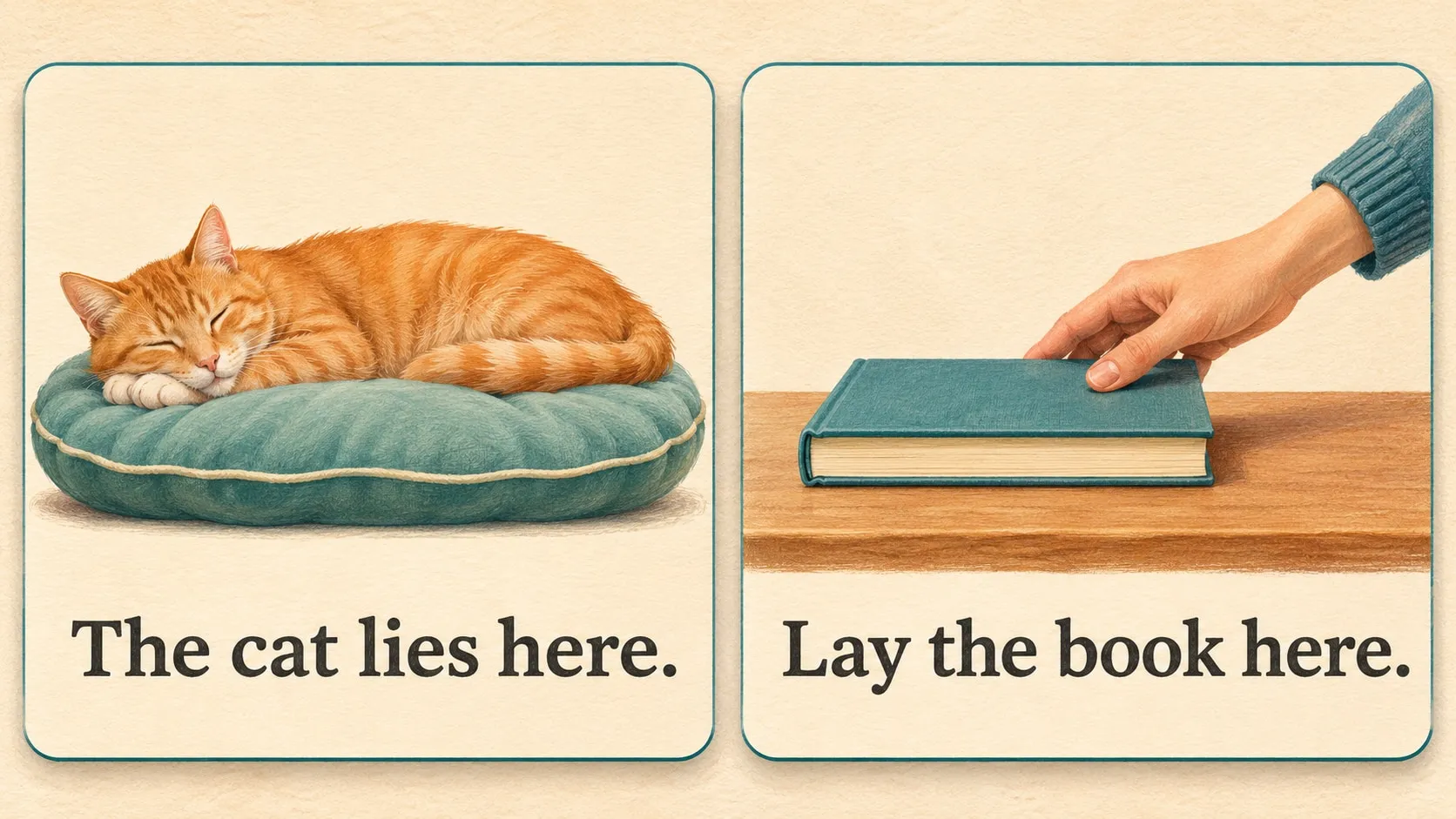
Lie means to be in, or move into, a reclining position. Lay means to put something down. Start with The cat lies here and Lay the book here: the cat is in a position; you are being asked to put a book in a position. Ask whether the subject is lying somewhere or placing something somewhere.
The confusing part is that lay is also the past tense of lie. A separate verb lie, meaning “say something untrue,” adds a third pattern. Keep the three rows separate rather than trying to memorize one long list.
The difference at a glance
| Meaning | Pattern | Example |
|---|---|---|
| Be in or take a reclining position | lie + optional place expression | I lie on the sofa. |
| Put something down | lay + direct object + optional place expression | I lay the blanket on the sofa. |
| Say something untrue | lie / lie to + person | I never lie to my friends. |
Cambridge English Grammar Today explains these meanings and forms. The examples and practice below apply that distinction to everyday scenes.
Lie: the subject is in the position
With lie meaning “recline” or “be horizontal,” there is no direct object:
- The cat lies on the cushion.
- I need to lie down.
- The book is lying on the desk.
An object such as a book can be the subject of lie, too. The test is not “person or thing.” In the last example, the book is already there; nobody is putting it down in that sentence.
On the desk tells you where. It is a prepositional phrase, not a direct object. You also do not need a reflexive pronoun when you recline: I lie down, rather than I lie myself down.
Lay: someone puts something down
With lay, name the thing being placed:
- Please lay the book here.
- She lays the blanket on the sofa.
- He is laying the cards on the table.
The book, the blanket, and the cards are direct objects. For this meaning, try replacing lay with place: Please place the book here describes the same kind of action. This is a test for putting something down, not a rule for every idiom containing lay.
A pronoun can be the object: Lay it here. If you are asking someone to recline instead, the standard form is Lie down.
Lie, lay, lain versus lay, laid, laid
| Verb and meaning | Base form | Simple past | Past participle | -ing form |
|---|---|---|---|---|
| Recline / be horizontal | lie | lay | lain | lying |
| Put something down | lay | laid | laid | laying |
| Say something untrue | lie | lied | lied | lying |
Practice the rows with a time contrast:
- Today I lie down after lunch. Yesterday I lay down after lunch.
- Today I lay the book on the desk. Yesterday I laid it on the desk.
- He lied about his age. He has lied before. This is about telling an untruth.
After have/has, use the past participle: She has laid the blanket on the bed. The participle for reclining or being horizontal is lain: The envelope has lain unopened for weeks. It is correct but formal and uncommon. For an ongoing situation, The envelope has been lying there for weeks is a natural alternative.
The big trap is Yesterday I lay on the sofa. That is correct: lay is the past tense of lie here. Meaning, object, and time work together; the spelling alone does not identify the verb.
Three mistakes to catch
- Use laid, not “layed”: She laid the book down.
- Use lying, not “lieing”: Both verbs spelled lie form lying. Laying belongs to lay.
- Do not use lied for reclining: I lied yesterday means that you said something untrue. I lay in bed yesterday describes your position.
Compare He is lying to me with He is lying on the sofa. The rest of the sentence tells you which meaning of lying is intended.
Ten exercises
Complete each sentence with a form of lie or lay. Check the meaning and the time. One item involves telling an untruth.
- Every afternoon, I ___ down for ten minutes.
- Please ___ the notebook on my desk.
- Yesterday, the dog ___ beside the door all evening.
- Yesterday, Mia ___ the blanket on the bed.
- Look! The cat is ___ on your jacket.
- Look! Ben is ___ the cards on the table.
- She has already ___ the towels on the bed.
- The unopened letter has ___ in that drawer for years.
- He ___ to us about his age yesterday.
- Every evening, she ___ her glasses beside the bed.
Answers with explanations
- lie — A repeated action of reclining; no direct object.
- lay — An instruction to put down the notebook.
- lay — Simple past of lie: the dog was in that position.
- laid — Simple past of lay, with the blanket as its object.
- lying — The cat is in a position, not placing anything.
- laying — Ben is placing the cards.
- laid — After has, use the participle of lay.
- lain — The participle of lie; correct but formal. An everyday alternative is has been lying.
- lied — Saying something untrue in the past.
- lays — Third-person singular simple present, with her glasses as its object.
Practice whole phrases, then change the time
Try The book is lying here. / I am laying the book here. Then retell the scene as something that happened yesterday: The book lay here. / I laid the book here. Say the object aloud. You are practicing a sentence choice rather than just reciting verb forms.
In Lingo Phrase Cards, choose an offered language pair and an accessible set, recall the phrase before turning the card, and compare your answer with the other side. Target-language phrases include IPA and prerecorded neural text-to-speech audio. In regular Leitner study, you assess your answer after turning the card; free pool, box, and error-card practice does not change card progress. Some categorized sets require a license.
For a related object test, see rise vs raise. For this pair, keep Lie down — lay something down in mind. Explore the available language directions and sets on the Lingo page.