Sidereal day vs. solar day: Why stars appear earlier each night
Why do stars return about four minutes earlier each night? Understand sidereal and solar days, Earth's rotation, and a simple way to observe the shift.
Look for the same constellation at the same clock time on several clear evenings. After a few weeks, it will have moved noticeably westward. Stars return to the same position in the sky about four minutes earlier each day. The explanation combines Earth’s daily rotation with its yearly orbit around the Sun.
A rotation measured against distant stars takes about 23 hours and 56 minutes: a sidereal day. A mean solar day lasts 24 hours. That small difference helps explain why our evening sky changes through the year.
One rotation, two reference points
Saying “Earth has turned once” leaves an important question unanswered: turned once relative to what?
| Measure | What marks one completed cycle? | Approximate length |
|---|---|---|
| Sidereal day | A distant star returns to the same local meridian | 23 h 56 min |
| Mean solar day | An imaginary mean Sun returns to that meridian | 24 h |
Your local meridian is the imaginary line across the sky through the north point, the zenith overhead, and the south point. In this article, a star’s daily meridian crossing means its upper transit: the highest point on its daily path. That reference works even for a star that never rises or sets at your location.
OpenStax’s introduction to astronomical timekeeping explains these two ways of measuring a day. The values here are deliberately rounded.
Why the Sun needs a little extra turn
Imagine looking down on Earth from above the North Pole. It spins on its axis and travels around the Sun, both counterclockwise from this viewpoint.
After one rotation relative to distant stars, a marked place on Earth points in the same direction in space again. But Earth has also moved along its orbit. The direction to the nearby Sun has changed, so Earth must turn a little farther before the Sun crosses that place’s meridian again.
On average, Earth travels just under one degree along its orbit per day: roughly 360 degrees in a year. Rotating through the extra degree takes about four minutes. This makes the solar day longer than the sidereal day. NASA’s Earth facts likewise give a rotation period of about 23.9 hours.
Try picturing a ball and a lamp. Mark one spot on the ball and point it at the lamp. Now rotate the ball once while moving it a short distance around the lamp. After exactly one spin, the mark points in its original direction across the room, but no longer straight at the lamp. A small additional turn brings the lamp back into alignment.
Four minutes becomes two hours in a month
The difference is hard to notice from one evening to the next, but it adds up.
An illustrative calculation: suppose a star reaches its highest point tonight at 10:00 p.m. You stay at the same observing site, with no daylight-saving or other clock change during the comparison.
| Time after the first evening | Approximate upper transit |
|---|---|
| 1 day | 9:56 p.m. |
| 7 days | 9:32 p.m. |
| 30 days | 8:00 p.m. |
These are rounded examples using four minutes per day, not predictions for a named star. Look at the sky at a fixed clock time instead, and the star pattern will be farther west along its daily path after a few weeks.
For stars that rise at your location, rising times also shift earlier. Circumpolar stars are different: they remain above the horizon rather than rising and setting each day, yet still return to the same position earlier. The article on finding the North Star explains the unusual-looking motion near the celestial pole.
Why the evening constellations change with the seasons
The daily shift is part of the yearly pattern. As Earth orbits, its night side faces different directions in space. A constellation prominent on winter evenings may be near the Sun in the daytime sky at the corresponding time six months later.
NASA’s guide to constellations describes how this works. The stars do not have to rearrange themselves each year. We are viewing them from an orbiting planet and comparing their positions using clocks that follow the solar day.
Your latitude also matters. “Winter constellation” is therefore not a description of the same viewing conditions everywhere on Earth. The cause of warm and cold seasons is a separate question, mainly explained by Earth’s axial tilt.
A simple observing project
- Choose an obvious star pattern and a fixed spot with a clear view.
- Record the date and time, then sketch the pattern’s position relative to a roofline or another fixed landmark.
- Repeat one or two weeks later at the same clock time. Avoid an interval containing a daylight-saving change.
- Try looking about half an hour earlier as well. After a little over a week, the pattern should be close to its original position at that earlier time.
Use stars rather than the Moon or planets, which also move against the stellar background. Clouds, twilight, and obstructions will affect what you can see.
Why everyday clocks still use 24 hours
Our daily schedule needs to stay tied to the cycle of sunlight and darkness. A clock running on sidereal days would gain roughly four minutes on the Sun each day. After several months, the same reading would correspond to a very different part of the daylight cycle.
The real Sun does not keep perfectly uniform clock time throughout the year either. Earth’s elliptical orbit and axial tilt make the apparent solar day vary slightly. The familiar 24-hour figure refers to the mean solar day. For another distinction—between local solar noon and official clock time—see the guide to time zones and longitude.
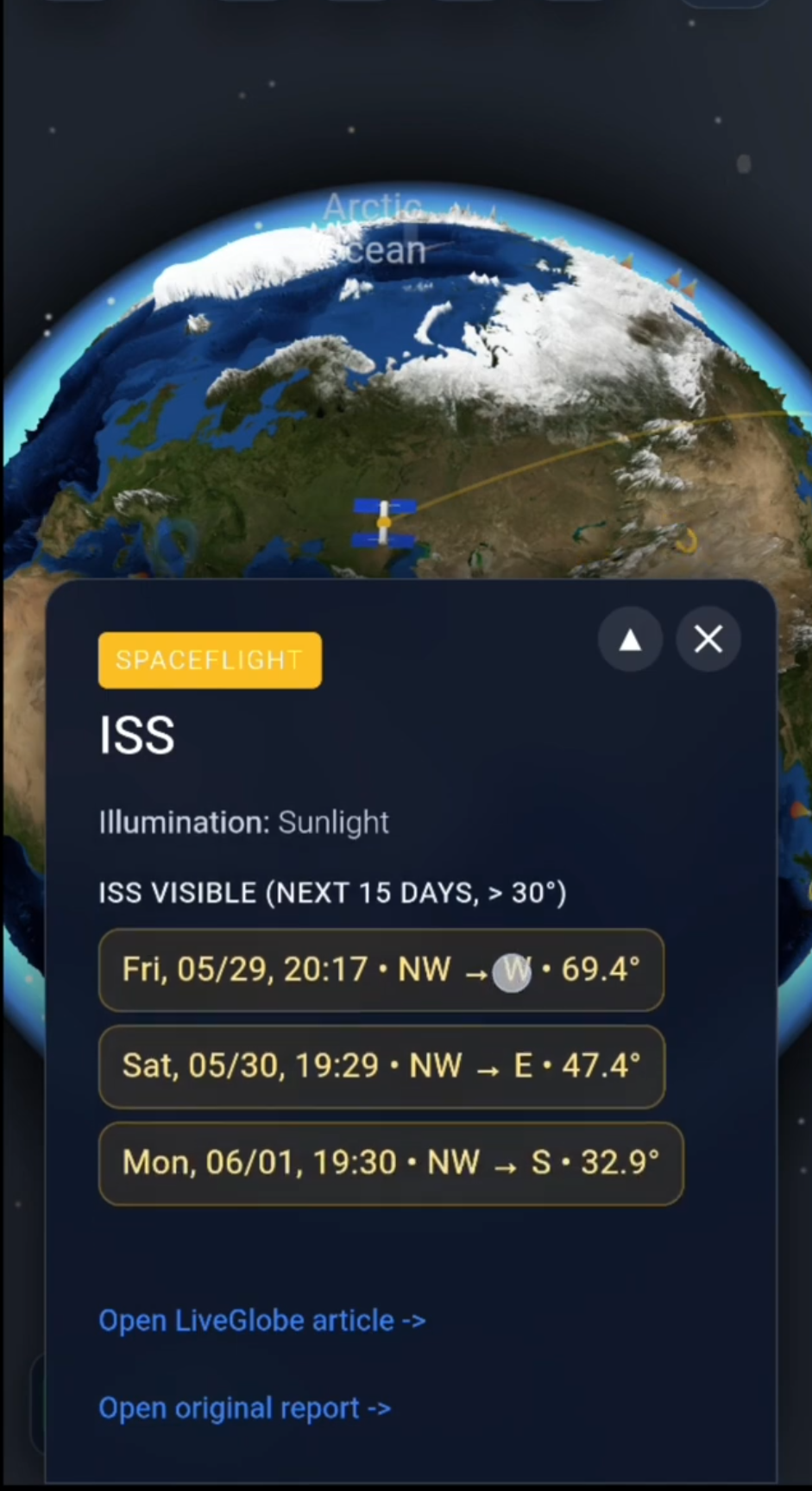
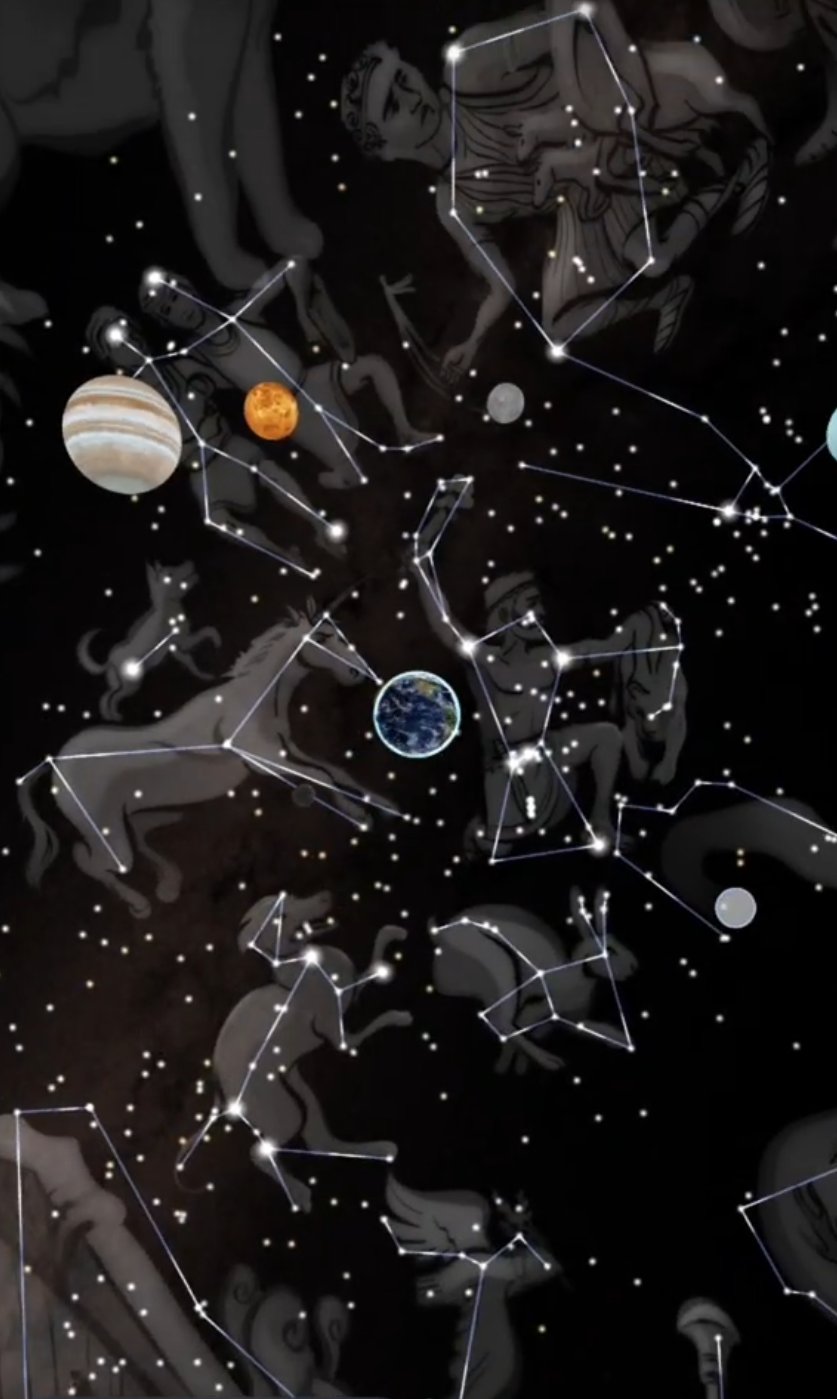
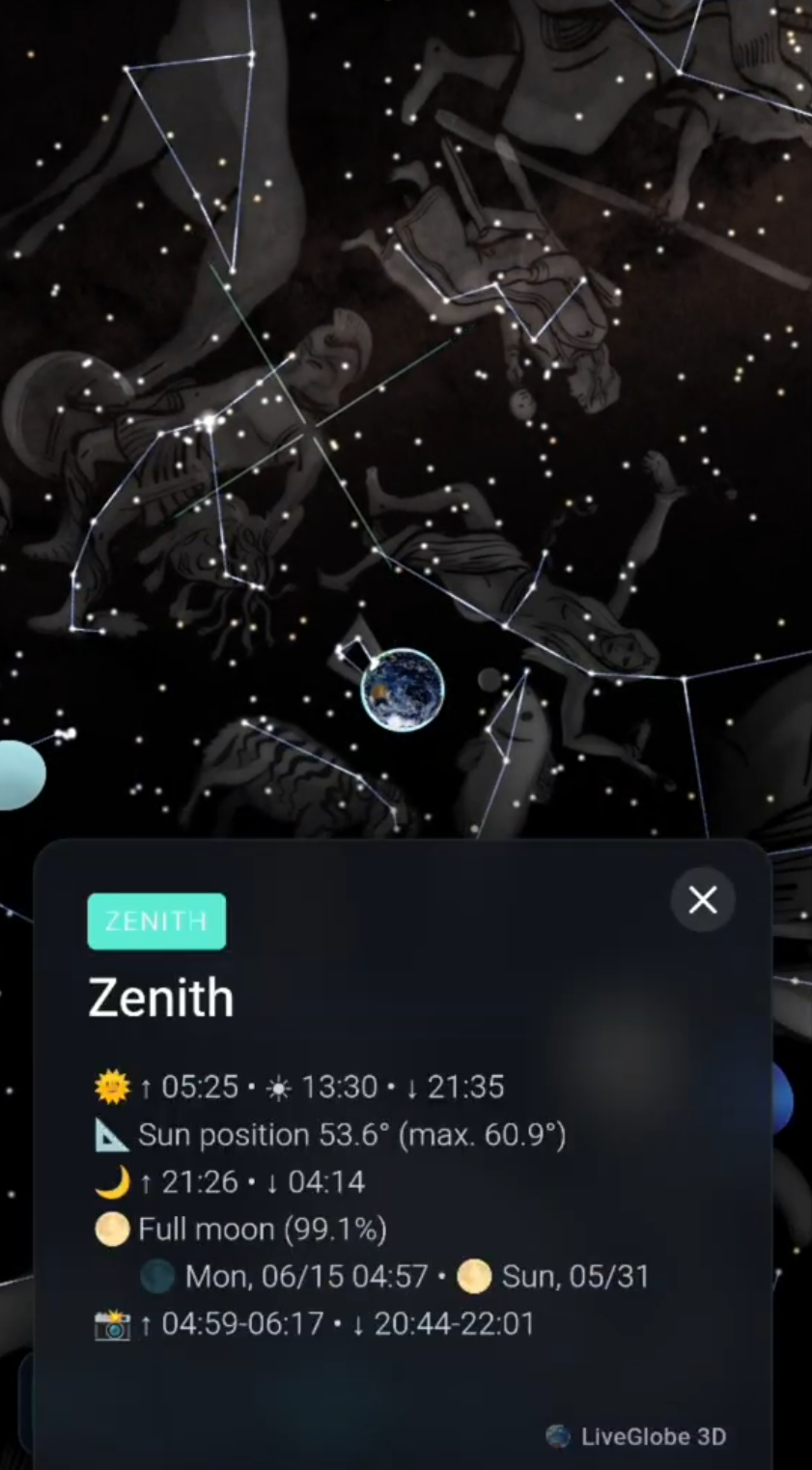
To get your bearings, LiveGlobe 3D lets you switch between Earth and sky views and enable constellation lines in the space menu. The checked web-app configuration requires a sign-in. Pick out a recognizable pattern as a starting point for your next evening outdoors.
Remember: one turn relative to the stars is not quite one turn relative to the Sun. That small extra rotation connects our 24-hour clocks to the changing evening sky.
Short clips
The app in motion: short, genuine glimpses straight from use.
At a glance
How the app feels on your phone.