Morning or evening? Practise the 12- and 24-hour clock
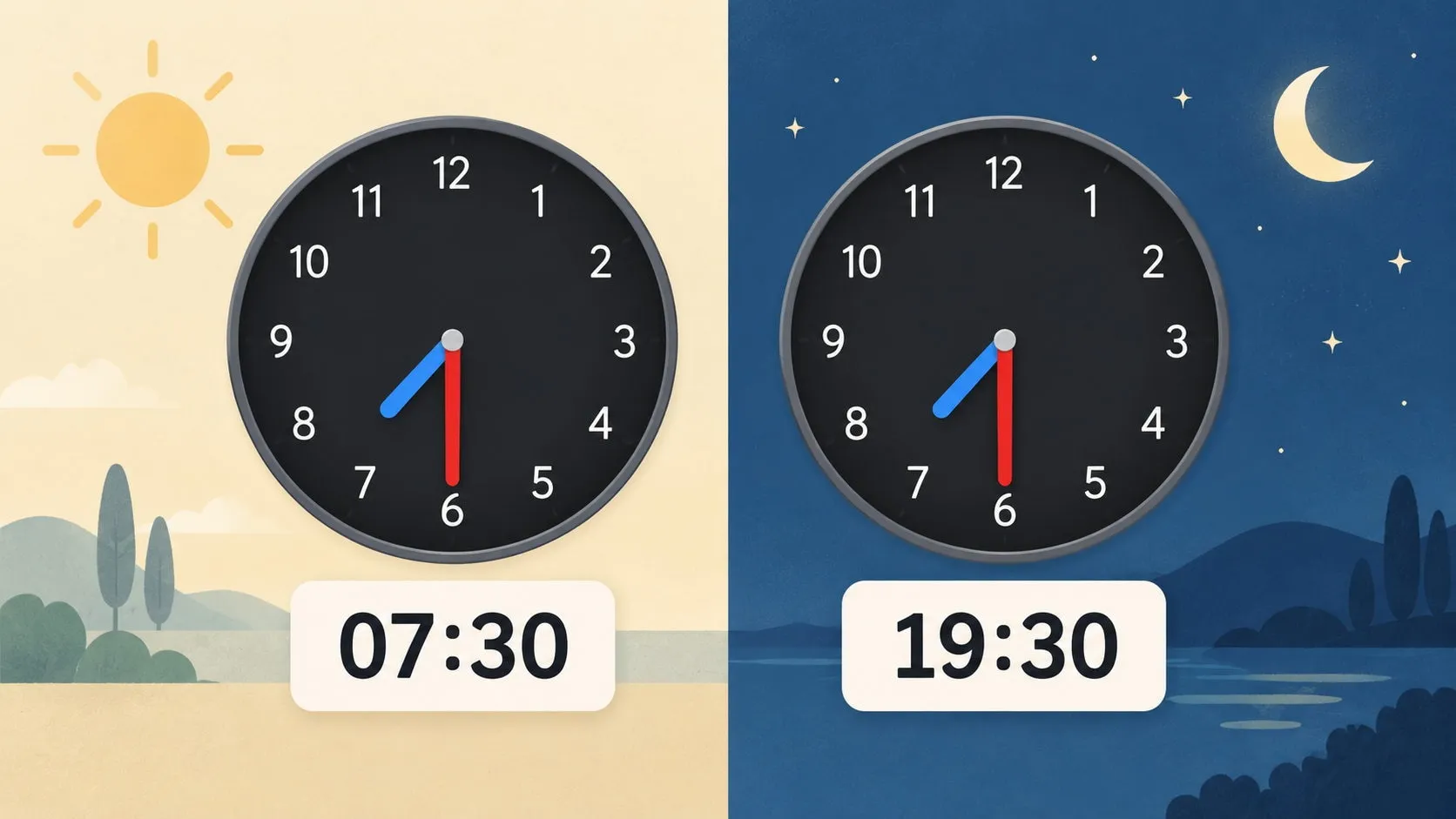
7:30 in the morning and 7:30 in the evening look identical on an ordinary analogue clock. The long hand points to 6 and the short hand sits halfway between 7 and 8. In the 24-hour format, however, those times are 07:30 and 19:30. The hands alone cannot tell you which one is meant.
These activities help children connect the clock face with an explicit time-of-day clue and then write the matching digital time. You only need paper and a clock with twelve numbers. Keep the answers covered until you have tried the questions.
Read the hands, then check the clue
A twelve-number clock repeats each hand position twice within a 24-hour day. Hours 1 to 11 may belong to either half of that day. The minutes stay the same when you change between the two possibilities.
Use this three-step routine:
- Read both hands. Which hour has the short hand reached or passed? How many minutes does the long hand show?
- Find the time-of-day clue. Look for “in the morning”, “in the afternoon”, “in the evening”, “noon” or “midnight”. An activity such as eating or playing does not, by itself, fix the time.
- Write the 24-hour time. Seven in the morning becomes 07:00; seven in the evening becomes 19:00. The initial zero simply makes the display consistent.
If reading the hands is still tricky, start with the guide to reading an analogue clock in five-minute steps. This activity adds the missing time-of-day information once you can read the face.
One clock face, two digital times
For the hours 1 to 11 after noon, add twelve to the hour to write it in the 24-hour format. For example, 2:15 in the afternoon becomes 14:15. The 15 minutes do not change.
| Clock-face time | First half of the day | Second half of the day |
|---|---|---|
| 7:30 | 07:30, morning | 19:30, evening |
| 2:15 | 02:15, during the night | 14:15, afternoon |
| 9:45 | 09:45, morning | 21:45, evening |
You may also see am and pm: 7:30 am is 07:30, while 7:30 pm is 19:30. Twelve needs special care. Noon is 12:00; midnight at the start of a new day is 00:00. Both hands point to 12 in either case. Half past noon is 12:30, not 24:30, so “always add twelve after noon” is not a rule for every hour.
The Time and Date conversion chart explains these mappings, including the usual am/pm labels. Writing “noon” and “midnight” in full keeps the practice questions clear.
Six questions: which digital time fits?
Write the digital time and a short explanation for each question. One question deliberately leaves out an important clue. Can you spot it?
1. Before heading out
It is morning. The long hand points to 6 and the short hand is exactly halfway between 7 and 8. What time would you write?
2. Playing in the afternoon
It is explicitly afternoon. The long hand points to 3 and the short hand is a quarter of the way from 2 to 3. Which 24-hour time fits?
3. Reading in the evening
It is evening. The long hand points to 9 and the short hand is three quarters of the way from 9 to 10. What time is meant?
4. Exactly at noon
It is exactly noon. Both hands point to 12. How do you write that in the 24-hour format?
5. A new day begins
It is midnight at the start of the new day. Both hands point to 12 again. What time would you write now?
6. A clock with no time-of-day clue
The long hand points to 6 and the short hand is halfway between 8 and 9. You can see only the clock, with no label or story. Can you decide whether it means 08:30 or 20:30?
Answers and explanations
- 07:30. The minute hand on 6 means 30 minutes. The short hand has passed 7 but has not reached 8. “Morning” selects 07 rather than 19.
- 14:15. The long hand on 3 means 15 minutes; the short hand still belongs to hour 2. In the afternoon, 2 + 12 gives 14. Keep the minutes as 15.
- 21:45. The long hand on 9 means 45 minutes. The short hand is close to 10 but has not reached it: the face reads 9:45. In the evening, 9 + 12 gives hour 21.
- 12:00. “Noon” tells you which of the two times with both hands on 12 is intended.
- 00:00. This story names the start of a new day. The hands look the same as they do at noon, but the clue changes the digital time.
- No, there is not enough information. Both 08:30 and 20:30 match the hands. Asking for the missing time-of-day clue is the right response.
If an answer is wrong, ask a specific question: “Did you read the hands differently, or miss the time-of-day clue?” That separates two different difficulties. Daylight or darkness is not a reliable substitute for the stated clue.
Make your own partner cards
Write two cards for the same hand position: “07:30 — morning” and “19:30 — evening”. Set the analogue clock to 7:30 and place one card beside it, then the other. What changes? The digital hour and the time-of-day clue. What stays the same? Both hands and the 30 minutes.
Next, one person sets a new time and gives only the time-of-day clue. The other writes the matching digital time and explains it. Swap roles. Occasionally leave out the clue on purpose: “I cannot tell yet” can be a correct answer.
Try 06:15/18:15 or 10:20/22:20 for another round. Give clear clues such as “morning” and “evening”, rather than asking someone to guess the hour from an activity.
Try the free practice clock
In the web interface called UhrenABC, open the free practice clock (“Zeit üben” in the German interface). Use the hour and minute sliders to set 7:30 and compare the hands, digital displays and written time. Then add your own morning/evening cards and check the 24-hour answers together.
The free clock is for exploration and does not mark your cards. The answer check in the hand-setting activity also compares positions on a 12-hour clock; it does not decide whether your story happens in the morning or evening.
Finish with one hand position and two different time-of-day clues. Explaining both digital times shows that you have identified the extra information needed to make the clock reading unambiguous.