Quarter past, half past or quarter to? Read the words on an analogue clock
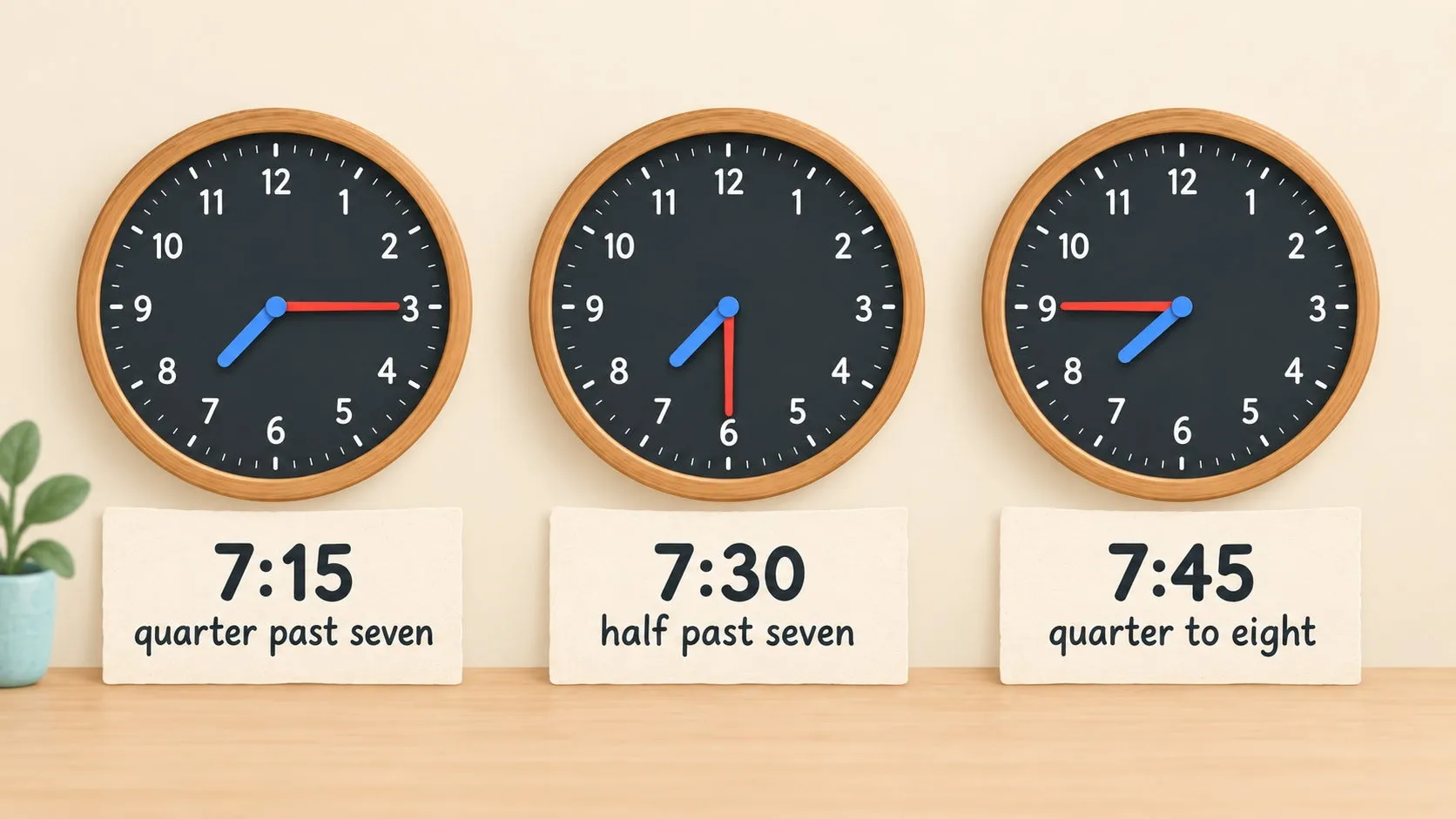
7:15 is quarter past seven, 7:30 is half past seven and 7:45 is quarter to eight. With past, you count minutes after an hour the clock has already reached. With to, you count the minutes left before the next whole hour. The hands make that difference visible: the minute hand tells you how far through the hour you are, while the hour hand moves gradually towards the next number.
For children learning to tell the time, or anyone learning English time expressions, it helps to connect the words, the digital time and both hands. Start with three positions rather than a long list of phrases. Then use the same reasoning with other five-minute times.
Past looks back; to looks ahead
Imagine the hour from 7:00 to 8:00. An hour has 60 minutes. At 7:15, fifteen minutes have passed since seven: one quarter of an hour. That gives you quarter past seven.
At 7:45, only fifteen minutes remain before eight. Quarter to eight names that remaining quarter of an hour. Notice that eight is the next whole hour, even though the short hand has not reached 8 yet.
The same idea works with other times:
- 7:20: twenty past seven — twenty minutes after seven.
- 7:40: twenty to eight — twenty minutes before eight, because 60 − 40 = 20.
For this way of telling the time, a useful pattern is past up to and including half past, then to with the following hour. It is a familiar pattern, not the only correct way to speak. Cambridge’s guide to telling the time also gives number-based alternatives such as seven forty.
Match the words to 3, 6 and 9
The long minute hand points to 3 for fifteen minutes, 6 for thirty and 9 for forty-five. Meanwhile, the short hour hand keeps moving between 7 and 8. It does not stay on 7 until the minute hand completes its circuit.
| Time | Words | Minute hand | Hour hand |
|---|---|---|---|
| 7:00 | seven o’clock | on 12 | exactly on 7 |
| 7:15 | quarter past seven | on 3 | a quarter of the way from 7 to 8 |
| 7:30 | half past seven | on 6 | halfway between 7 and 8 |
| 7:45 | quarter to eight | on 9 | three-quarters of the way towards 8 |
| 8:00 | eight o’clock | on 12 | exactly on 8 |
At quarter to eight, the hour hand should therefore be close to 8, but not on it. If the minute values are still unfamiliar, use the guide to reading a clock in five-minute steps.
Half past seven starts from seven
Half past seven means half an hour after seven, so it is 7:30. To check it, begin at seven o’clock and move forward thirty minutes. The minute hand reaches 6 and the hour hand is halfway towards 8.
- Half past six = 6:30.
- Half past seven = 7:30.
- Half past eight = 8:30.
If you also use German, be careful with a different convention: German halb acht is 7:30, the same time as half past seven. The German phrase names the coming hour; the English phrase names the hour that has passed. Translate the complete expression rather than matching the number words alone.
In informal British speech, you may hear half seven. That also means 7:30. The full form half past seven is useful when learning because it makes the direction explicit.
Use a four-step check
Take a movable practice clock or draw a dial. Set 7:15 before saying it aloud:
- Find the minutes: :15 puts the long hand on 3.
- Check the hour: the short hand has passed 7 but has not reached 8.
- Choose the direction: fifteen minutes after seven is past seven.
- Say the sentence: It’s quarter past seven.
Now try 7:45. The long hand points to 9; the short hand is closer to 8. Ask, “How many minutes until eight?” Fifteen remain, so say It’s quarter to eight.
For a partner activity, one person says a time and the other sets the hands. Check both hands together, swap roles and finish by writing the digital time. This makes it easier to spot whether an error concerns the minutes or the hour named in the phrase.
Seven fifteen is correct too
You can also say seven fifteen, seven thirty and seven forty-five. These forms follow the digital display directly, without switching to the next hour. Quarter to eight and seven forty-five describe the same time.
Use o’clock for whole hours: seven o’clock. Do not add it to quarter past seven.
The hands alone do not tell you whether this is 7:15 in the morning or 19:15 in the evening. You need the context or an extra indication of the time of day. In the questions below, focus on the hand positions on a twelve-hour clock.
Four questions with answers
Cover the answers first. Set or draw both hands and write each digital time.
- You hear quarter past four. What time and hand positions fit?
- Where should the hands be for half past nine?
- The long hand is on 9; the short hand is between 2 and 3, close to 3. Say the time using to.
- It is 11:40. What is the to phrase, and which hour does it name?
Answers:
- 4:15: minute hand on 3; hour hand a quarter of the way from 4 to 5.
- 9:30: minute hand on 6; hour hand halfway between 9 and 10. Thirty minutes have passed since nine.
- 2:45, quarter to three: fifteen minutes remain before three; the hour hand has not reached 3 yet.
- Twenty to twelve: twenty minutes remain from 11:40 to 12:00. The minute hand is on 8; the hour hand is between 11 and 12, closer to 12.
If an answer does not fit, ask whether you are counting after the last whole hour or before the next one. Then check the short hand.
Explore the English words on a practice clock
In the web interface labelled UhrenABC, choose English in the language settings. Open the free practice clock and use the hour and minute sliders to set 7:15, 7:30 and 7:45 in turn. Compare the hands, digital displays and written time. One selected language controls both the interface and time expressions; the free clock is for exploration and does not mark answers.
For tasks with answer checking, select the quarter-hour mode for the reading exercise, then arrange the word tiles to match each generated clock. This mode includes whole and half hours as well. The app uses one language variant at a time; any comparisons with another language are part of your own discussion.
Try it: compare 7:15 and 7:45 and explain why one uses past seven and the other to eight. Add 7:30 next. With both hands and the hour reference in place, the words follow from the time.