Read an analogue clock in five-minute steps
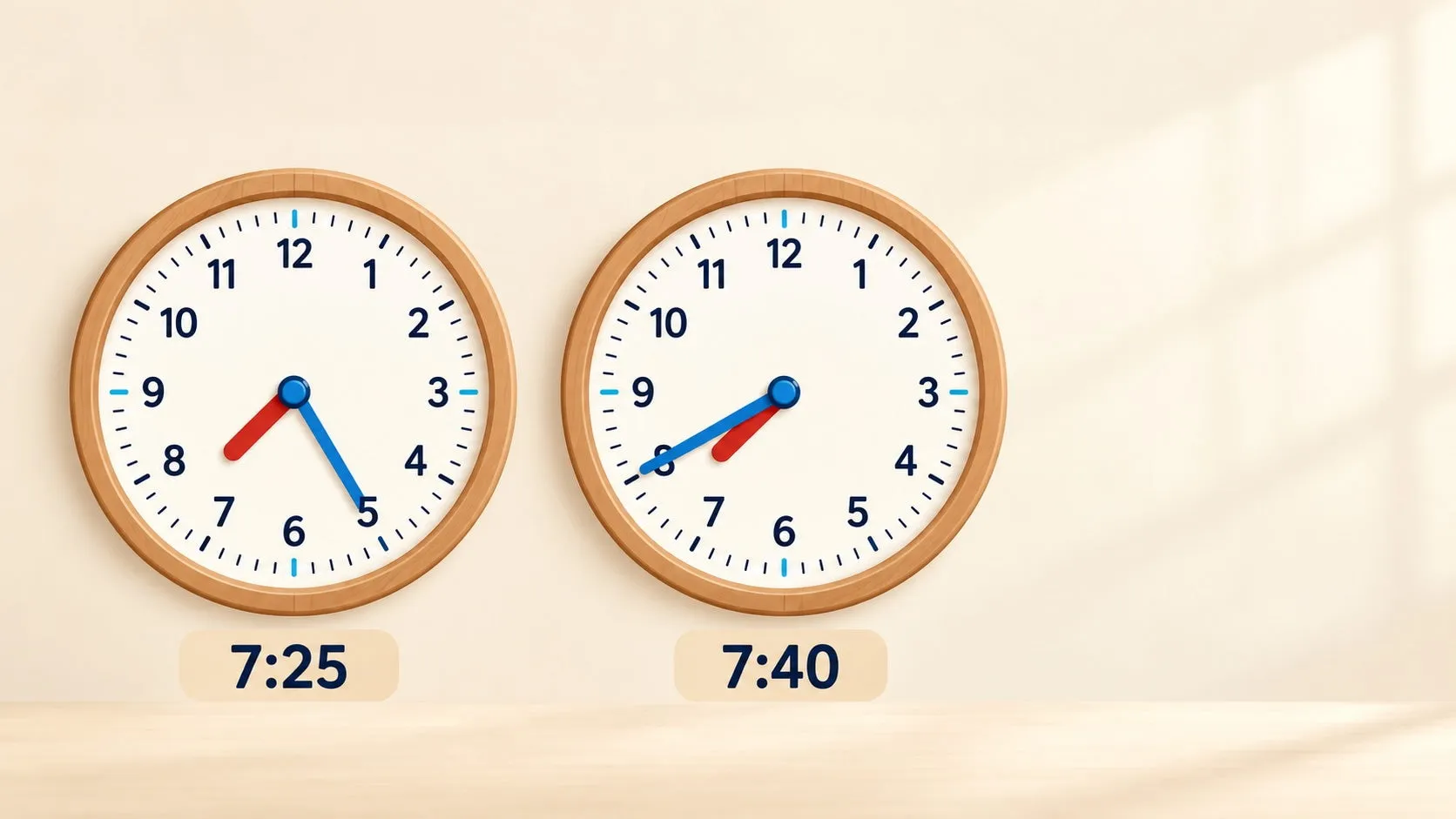
The long hand is pointing to 5. Does that mean five minutes? No: from the top of the clock to the 5, the hand has moved through five intervals of five minutes, or 25 minutes. If the short hand is between 7 and 8, the clock reads 7:25. The same counting rule works all the way round the dial.
Count minutes around the face
One hour has 60 minutes. The minute hand makes one complete circuit from 12 back to 12 during that hour. The twelve spaces between the numbered positions each account for five minutes. Meanwhile, the shorter hour hand moves gradually towards the next number.
At 12, the minute count is :00: a new hour has just begun. At 1, it is :05; at 2, :10. Add five at every number. At 11, you reach :55. The next stop at 12 marks :00 of the following hour.
| Long hand on | Minutes | Long hand on | Minutes |
|---|---|---|---|
| 12 | :00 | 6 | :30 |
| 1 | :05 | 7 | :35 |
| 2 | :10 | 8 | :40 |
| 3 | :15 | 9 | :45 |
| 4 | :20 | 10 | :50 |
| 5 | :25 | 11 | :55 |
Try counting aloud: 5, 10, 15, 20, 25 … When the minute hand points to the 8, it means 40 minutes, not eight minutes. This table is for hands pointing at the numbered positions; on clocks with smaller marks between them, those marks can indicate individual minutes.
Read both hands together: 7:25 and 7:40
First look at the short hand. Between 7 and 8, it has already passed 7 but has not reached 8, so the hour is still 7. Then check the long hand:
- 7:25: long hand on 5 for 25 minutes; short hand a little way past 7.
- 7:40: long hand on 8 for 40 minutes; short hand noticeably nearer to 8, but not on it yet.
At 7:55, the long hand is on 11 and the short hand is nearly at 8. Only at 8:00 does the long hand reach 12 and the short hand point exactly to 8. That helps avoid calling 7:55 “8:55”.
The hands alone cannot tell you whether this is 7:25 in the morning or 19:25 in the evening. You need the context of the day; the hand positions are identical.
Three quick questions
Cover the answers. Name the hour the short hand has passed, then count round to the long hand in fives.
- The short hand is just past 4 and the long hand is on 2. What time is it?
- The short hand is between 9 and 10, more than halfway across, and the long hand is on 7. What time is it?
- The short hand is almost at 3 and the long hand is on 10. What time is it?
Answers:
- 4:10: two five-minute spaces make 10 minutes; the short hand is past 4.
- 9:35: seven spaces make 35 minutes; the hour hand is already closer to 10.
- 2:50: ten spaces make 50 minutes; the hour hand has not yet reached 3. When the long hand reaches 12, it becomes 3:00.
If an answer feels wrong, check whether the hour hand is moving closer to the next number as the minute hand travels round the face.
Explore the steps on a practice clock
In the web interface labelled UhrenABC, open the free practice clock (“Zeit üben” in the German interface) and move the hour and minute sliders. Compare the hands, digital displays and written time at 7:25 and 7:40. This clock is for exploration; it does not mark answers.
For checked tasks, use the settings to select the five-minute-step mode for setting the hands (“Zeiger drehen”) or reading the time (“Zeit ablesen”), then open the relevant exercise. In the first, you set a given time; in the second, you arrange word tiles to match a clock. The generated tasks use specified five-minute positions, not arbitrary single-minute times. The app uses one selected language variant for its interface and time expressions, rather than translating between two languages.
Try both example times on the free clock, then take turns naming a time in five-minute steps and explaining where both hands should point.