Clock detectives: spot and fix four hand-position mistakes
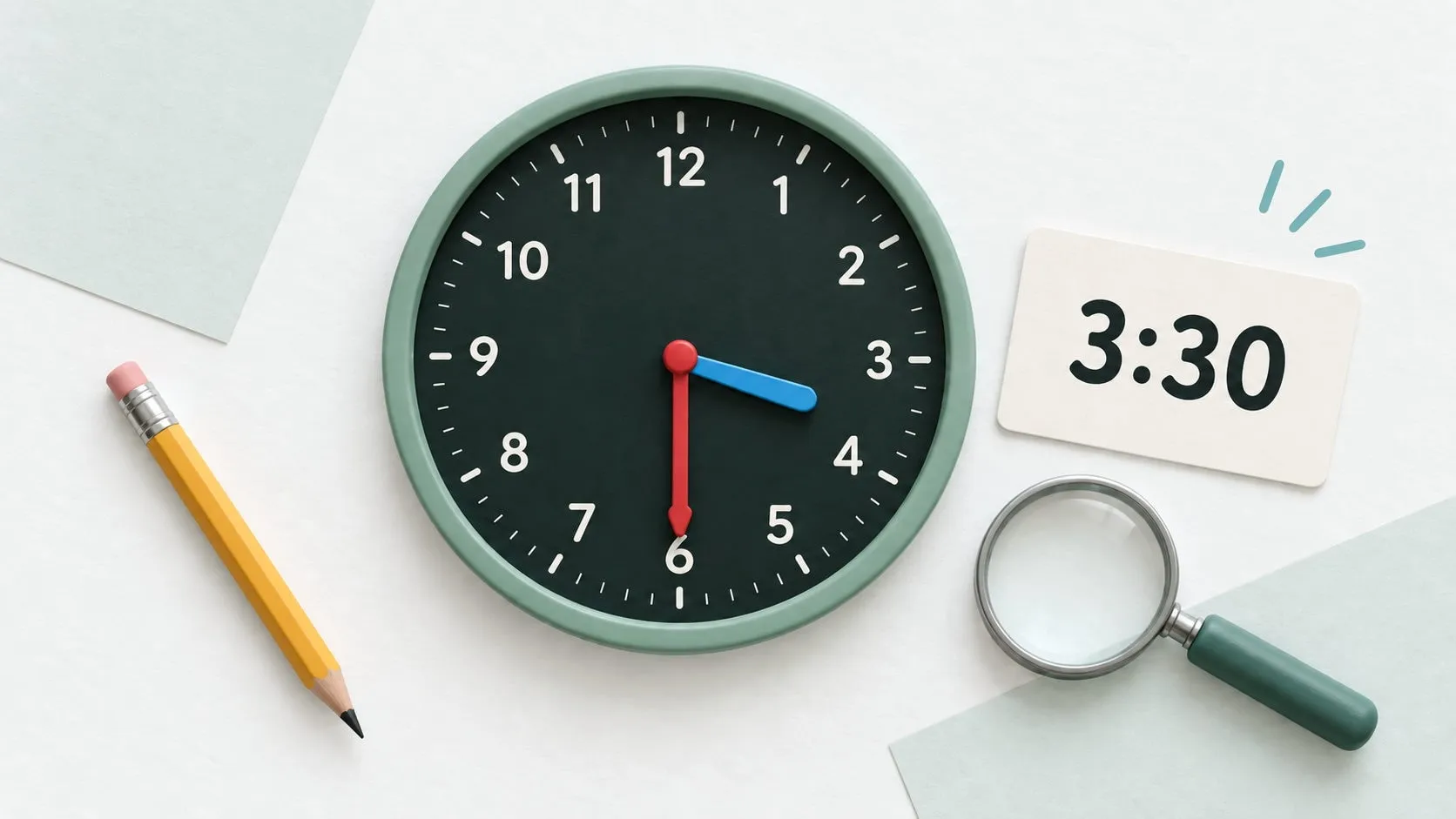
The time to draw is 3:30. The long hand points to 6, and the short hand points exactly to 3. Is everything right? Not quite: after half an hour, the short hand should be halfway between 3 and 4. Checking the minute hand alone is not enough.
In this detective round, you are looking for contradictions like this. Each case gives you a target time and a deliberately incorrect description of the hands. Find the mistake, change only what needs changing and explain why the corrected drawing works. All you need is paper and a pencil. Cover the answers until you have had a go.
Three questions to check each case
A standard analogue clock has a short hour hand and a long minute hand. As the long hand makes a full circuit, the short hand moves towards the next hour. It does not wait on one number until the hour is over. The Math Is Fun explanation of clocks illustrates this movement.
Check each description in this order:
- What time should the clock show? Read the digital target carefully: hours on the left, minutes on the right.
- Where should the long hand point? At 15 minutes, to 3; at 30, to 6; at 45, to 9. Count in fives to find the other numbered positions.
- How far has the short hand travelled? At 30 minutes, halfway to the next number; at 15, a quarter of the way; at 45, three-quarters of the way.
If the minute positions are still unfamiliar, start with reading an analogue clock in five-minute steps. This activity then asks you to compare an incorrect drawing with the time it is meant to show.
Four deliberately incorrect descriptions
These are mistake examples, not correctly set clocks. Sketch them on paper or work directly from the descriptions. For each case, write: Which hand is wrong? Where should it go? What can stay as it is?
Case 1: The short hand stays put
Target time: 3:30. The long hand points to 6, while the short hand points exactly to 3.
The explanation is: “The hour is three, so the short hand must stay on three.” Find the mistake and improve the drawing.
Case 2: The next hour arrives too soon
Target time: 6:45. The long hand points to 9, and the short hand is already exactly on 7.
“It is nearly seven, so I have drawn the short hand on seven.” Which part of that reasoning makes sense, and which part goes too far?
Case 3: The hands do not agree
Target time: 4:20. The short hand is one-third of the way from 4 to 5, and the long hand points to 2.
The note beside the drawing says: “The 2 means twenty minutes.” Check that claim. Do you really need to redraw both hands?
Case 4: The hands swap jobs
Target time: 8:15. The short hand points to 3. The long hand is a quarter of the way from 8 to 9.
Both directions might look familiar, but the drawing does not match the target. Which position belongs to which hand?
Answers: change only what needs changing
1. 3:30: Keep the long hand on 6. Move the short hand halfway between 3 and 4. Thirty out of sixty minutes is half an hour, so the hour hand has completed half its journey towards 4. “The hour is three” is right; “stay exactly on three” is not.
2. 6:45: Keep the long hand on 9. The short hand should be three-quarters of the way from 6 to 7: close to 7, but not there yet. “Nearly seven” describes the closeness correctly. The short hand reaches 7 exactly at 7:00, when the long hand is on 12.
3. 4:20: Leave the short hand one-third of the way from 4 to 5, because twenty minutes is one-third of sixty. Move the long hand from 2 to 4: four five-minute intervals make twenty minutes. On 2, it shows only ten minutes. Only one hand needs changing.
4. 8:15: The long minute hand belongs on 3. The short hour hand belongs a quarter of the way from 8 to 9. The directions were suitable, but they had been given to the wrong hands. Both the direction and the length must be right in the corrected drawing.
After each correction, read both hands together again. “I moved the short hand” describes an action; “because half an hour has passed” explains the reason.
Ask a question that gets to the reasoning
If an answer does not fit, try asking: “Did you count the minute position differently, move to the next hour too soon or mix up the hands?” That gives you a specific point to work on together.
For another round, one person writes 5:30 and draws the long hand on 6, but deliberately leaves the short hand exactly on 5. The other person moves only the short hand to the midpoint between 5 and 6 and explains why. Then swap roles.
Always label your own incorrect drawings as questions and provide a correct answer alongside them. That makes it clear which drawing shows the right time. If you include two separate mistakes, explain both in the answer.
Compare the target time on a practice clock
In the web interface labelled UhrenABC, open the free practice clock (“Zeit üben” in the German interface). Use the hour and minute sliders to set 3:30, then 6:45. Compare the hands and digital display with your corrected paper drawings. You can then set 4:20 and 8:15 and describe both hands.
The practice clock gives you a reference view; it does not automatically mark your paper exercises. Discuss together whether the mistake was found and clearly explained.
To finish, choose a case you initially found tricky. Set the correct time and complete the sentence: “This hand belongs here because…” A good detective answer explains the key relationship as well as naming the time.