How long between two times? Work out elapsed time on an analog clock
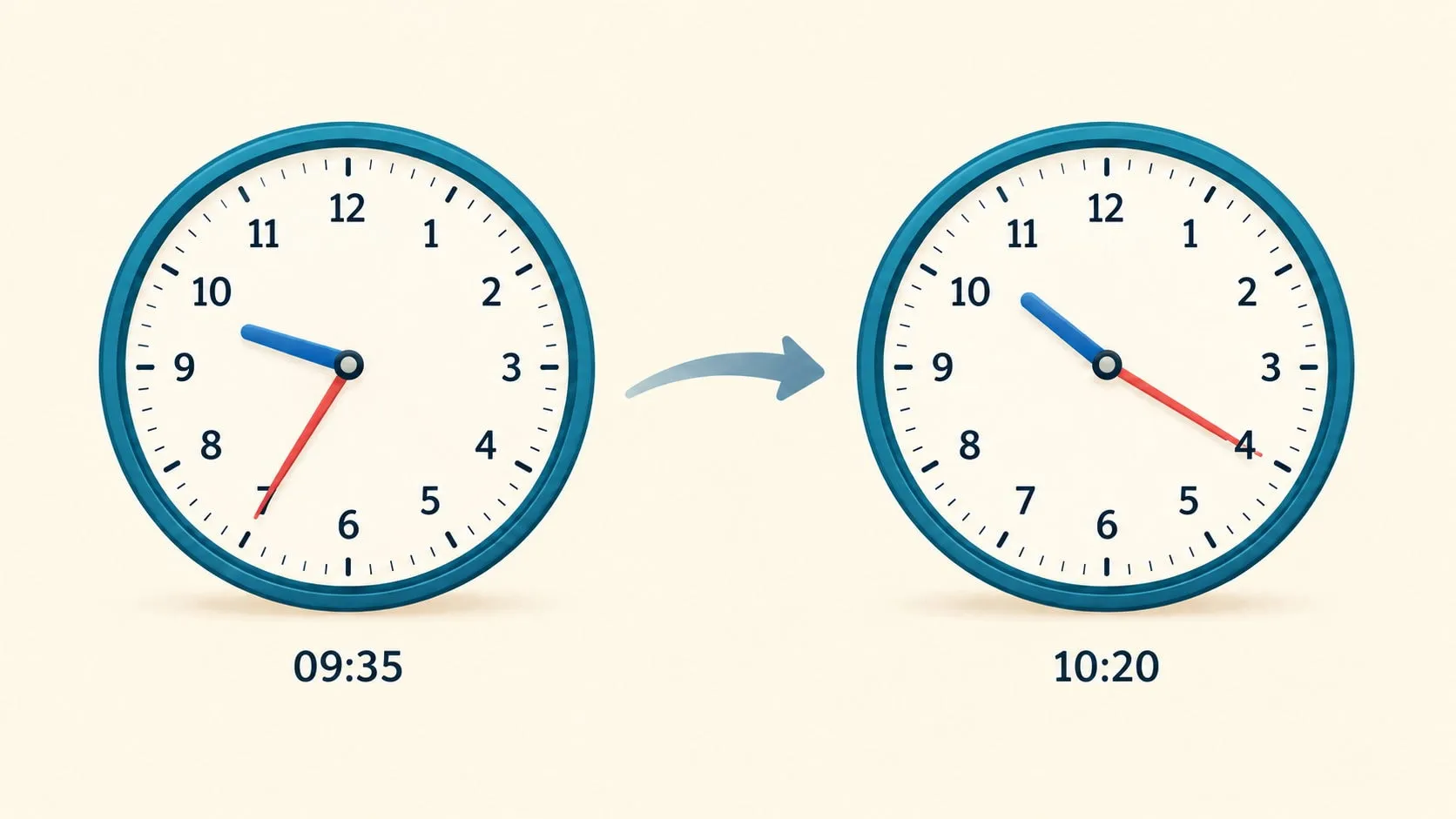
Something starts at 9:35 and finishes at 10:20. How long did it last? 45 minutes: 25 minutes take you to 10:00, and another 20 take you to 10:20. When the start and finish are known, the missing number is the duration, not another clock reading.
Start time, finish time, elapsed time
A clock reading marks a point in time. An elapsed time tells you how much time passed between two points. Write down what you know: start 9:35 → finish 10:20 → elapsed time ?. Count forwards from the start rather than treating the two clock readings as ordinary decimal numbers.
This question is different from “It is 9:35; what time will it be in 45 minutes?” That question gives you the duration and asks for the finish. Here you must find the duration.
Cross the hour in two steps
An hour contains 60 minutes. Start by finding the next whole hour:
| Step | Time reached | Minutes passed |
|---|---|---|
| Start | 9:35 | – |
| Reach the whole hour | 10:00 | 25 |
| Reach the finish | 10:20 | 20 more |
Add the lengths of the two stretches: 25 + 20 = 45 minutes. Check it by starting at 9:35 and counting forwards 45 minutes: you arrive at 10:20. On an analog clock, the long hand moves from 7 (:35) through 12 (:00) to 4 (:20). The short hand moves from between 9 and 10 to a little past 10.
Drawing a line with 9:35 → 10:00 → 10:20 helps prevent a common mistake: forgetting to count the minutes before the hour changes.
What if both times are in the same hour?
From 8:10 to 8:45, the hour does not change. Subtract the minute readings: 45 − 10 = 35 minutes. The minute hand moves from 2 (:10) to 9 (:45), seven five-minute steps. The hour hand is still between 8 and 9 at the end.
But subtracting just the minute readings for 9:35 → 10:20 would produce 20 − 35, a negative number even though the finish is later. Whenever the whole hour changes, count to that hour first and then continue.
When the hands pass 12
From 11:50 to 12:25, count 10 minutes to 12:00 and 25 minutes more to 12:25. The elapsed time is 35 minutes. The long hand travels from 10, through 12, to 5; the short hand moves from almost 12 to a little past it.
The hands on a twelve-hour clock look the same twice a day. You need the context to know whether this example is around noon or midnight. If an exercise spans a longer period or crosses a day, it must specify the relevant day and whether the times are morning or evening.
Try three questions
Mark the next whole hour as a stopping point before adding your minutes.
- A break runs from 8:45 to 9:20. How long is it?
- An activity begins at 10:15 and ends at 11:05. How many minutes pass?
- A game runs from 15:40 to 16:30. How long does it last?
Answers:
- 35 minutes: 15 minutes to 9:00, then 20 minutes to 9:20.
- 50 minutes: 45 minutes to 11:00, then 5 minutes to 11:05.
- 50 minutes: 20 minutes to 16:00, then 30 minutes to 16:30. The hands on a twelve-hour face would read 3:40 and 4:30; the 24-hour notation supplies the afternoon context.
If your answer seems wrong, add the duration you found to the start time. Do you reach the stated finish?
Compare both times on a practice clock
The web application labelled UhrenABC has a free practice clock: set 9:35, then 10:20, using the hour and minute controls and compare the hands with the digital and written displays. Work out the 45-minute difference yourself; the free clock does not mark that calculation.
Its separate time-duration exercise gives a start time and a duration and checks the finish time you set on a twelve-hour clock. That is the reverse type of question, explained in the guide to finding a finish time.
Try choosing two times in five-minute steps, setting them one after the other and counting the two stretches on either side of the whole hour.