Adding time on an analogue clock: find the finishing time
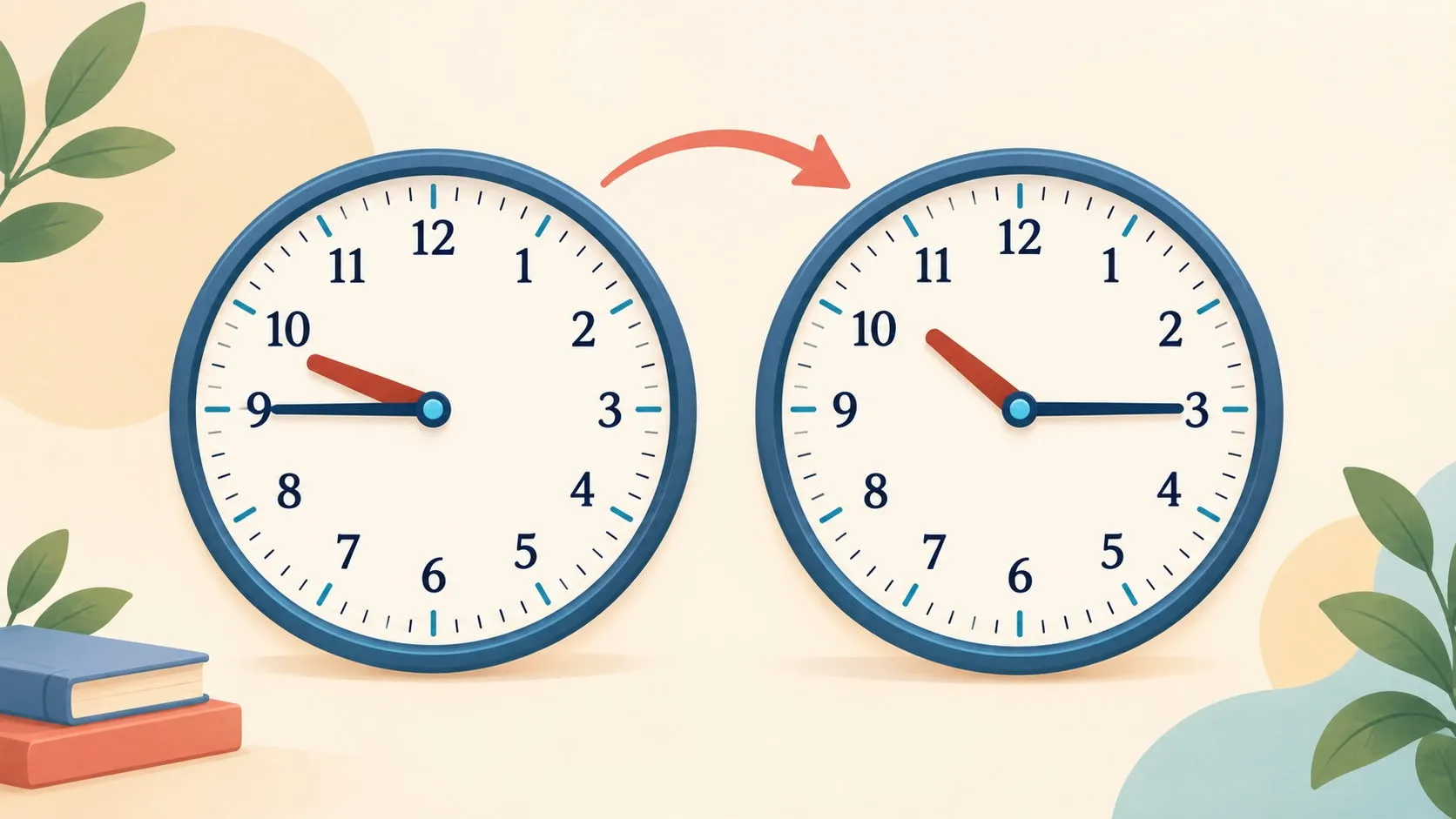
It is 9:45, and an activity starts 30 minutes later. What time should you put on the clock? The answer is 10:15. Rather than trying to add 30 to the digits 45, move forwards in two manageable parts: first to 10:00, then another 15 minutes.
A starting time is not a duration
9:45 is the starting time: a point on the clock. Thirty minutes is the duration, or the time between the start and finish. 10:15 is the finishing time. A time interval has a start and an end, and one hour contains 60 minutes. The labels are different even though we use minutes to describe both clock readings and durations.
On an analogue clock, the long minute hand completes one circuit in an hour. The shorter hour hand moves gradually throughout that hour. It does not wait at 9 until the minute hand reaches 12 and then jump to 10.
Work through the next whole hour: 9:45 + 30 minutes
From 9:45 to 10:00 is 15 minutes. That uses half of the 30-minute duration, leaving 15 minutes to add after 10:00.
| Stage | Time added | Clock time | Minute hand |
|---|---|---|---|
| Start | — | 9:45 | on 9 |
| Reach the hour | +15 minutes | 10:00 | on 12 |
| Use the remainder | +15 minutes | 10:15 | on 3 |
At 9:45 the hour hand is already close to 10. At 10:00 it points to 10; at 10:15 it has moved a little past 10. Check by counting backwards: 10:15 to 10:00 is 15 minutes, and 10:00 to 9:45 is another 15.
For a similar problem, ask three questions: How long until the next whole hour? How much of the duration remains? Where will both hands be at the end? This method also works when you simply draw a clock on paper.
When you do not cross a whole hour
Try 8:20 + 35 minutes. At 8:20 the minute hand points to the 4. Move forward seven five-minute steps: 25, 30, 35, 40, 45, 50, 55. The result is 8:55. The long hand points to 11 and the hour hand sits close to, but not yet on, 9.
Here is another check: 8:20 to 9:00 is 40 minutes. Stopping five minutes short of 9:00 gives a duration of 35 minutes, so 8:55 is right. 8:35 would be only 15 minutes after 8:20; it confuses the duration with the minute number on the clock.
Crossing 12 on the dial
For 11:30 + 45 minutes, count 30 minutes to 12:00 and then the remaining 15 minutes to 12:15. The minute hand travels from 6, past 12, to 3; the hour hand ends just beyond 12.
Those hand positions alone cannot tell you whether the time is after midnight or after midday. You need the context of the question for that. An analogue 12-hour dial is also not, by itself, a way of keeping track of dates.
Three short problems to try
Write down the starting time and duration. Find the finishing time and describe where both hands should end before looking at the answers.
- It is 9:40. A game begins 35 minutes later. When does it begin?
- Start at 3:15 and move forward 50 minutes. What time is it?
- An activity starts at 6:25 and lasts 40 minutes. When does it finish?
Answers:
- 10:15: 20 minutes to 10:00, then 15 more. Minute hand on 3; hour hand just past 10.
- 4:05: 45 minutes to 4:00, then 5 more. Minute hand on 1; hour hand just past 4.
- 7:05: 35 minutes to 7:00, then 5 more. Minute hand on 1; hour hand just past 7.
If an answer looks wrong, subtract the duration from your finishing time to see whether you return to the start.
Try the steps with a movable clock
In the web code reviewed for the application labelled UhrenABC, the time-duration exercise shows a starting time and a specified duration. You set the resulting time using the hands on a 12-hour clock, and that exercise checks the answer. Its questions use preset time steps; it is not an unrestricted calculator for any number of minutes or for dates.
Work out a short example together first, then set its finishing time. To explore hand positions without answer checking, use the separate free practice clock and compare its hands with the digital display. Talk through the two steps whenever the minute hand passes 12.