Bring vs take: choose the viewpoint, then try ten exercises
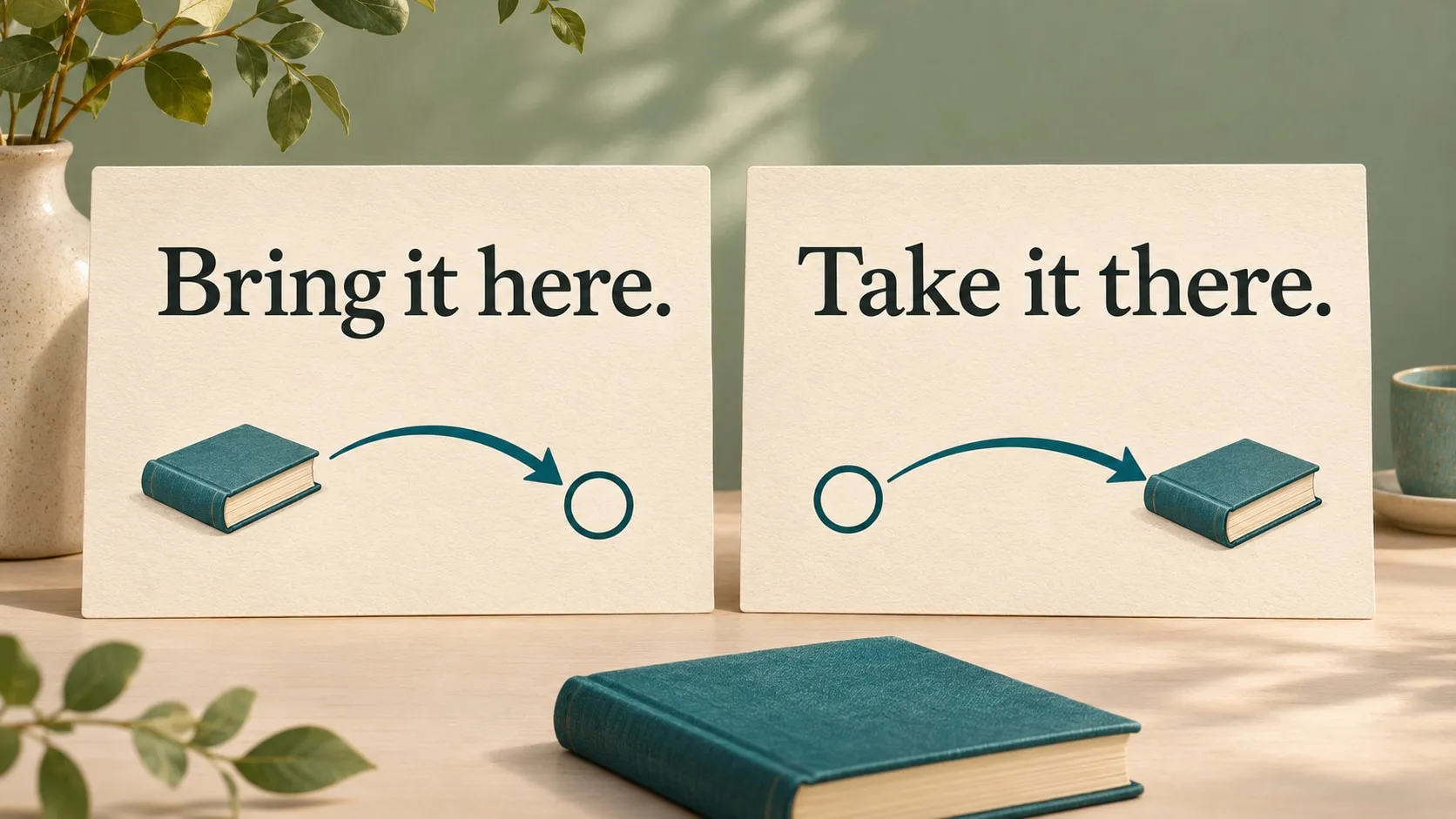
Bring it here and take it there describe moving the same kind of object. What changes is the viewpoint: are we watching something arrive at a reference point, or leave for another place? Translating a single verb from your first language may hide that distinction.
Use the situations below to practise bring and take, learn brought, took and taken, and check yourself with ten exercises and explained answers.
The basic difference
| Verb | Viewpoint | Example |
|---|---|---|
| bring | movement towards the speaker, listener or relevant receiver | Please bring the book here. |
| take | movement away from the reference point to another place | Please take the book there. |
The speaker’s location is a useful starting point, but it is not the only possible reference point. The listener’s location or a future meeting place can matter too. Cambridge English Grammar Today also explains how the same movement can be described from the mover’s or receiver’s viewpoint.
Bring: focus on arrival
You are at your desk and ask someone in the kitchen:
Can you bring me a glass of water?
The water is coming towards you. Now imagine inviting a friend to your home tomorrow:
Please bring your notebook when you come tomorrow.
You do not both have to be at the meeting place now. You are picturing the friend’s arrival there. On the phone, you can also say I’ll bring the documents to your office. You adopt the listener’s viewpoint at the office, even though you are currently elsewhere.
Take: focus on departure for another place
You and Alex are at home. Alex is leaving for the library while you stay behind:
Please take these books to the library.
The books move away from your shared starting point. Before someone leaves the house, you might also say Take an umbrella with you. Your viewpoint stays at the place they are leaving.
People can be the object too: I’ll take you to the station offers to drive or accompany someone there. In this situation, you are both still at home and the station is another destination.
One journey, two possible viewpoints
Mia leaves home to visit her father, carrying bread:
- Mia takes bread to her father. We follow Mia’s journey from her starting point.
- Mia brings bread to her father. We picture the bread arriving where her father is.
Both descriptions can work. A journey does not always force a single verb regardless of context. Ask whose location are we treating as the centre of the situation? That is more reliable than treating “here” as a fixed geographical rule.
This is different from borrow vs lend. With that pair, the subject’s role as temporary receiver or giver decides the verb. With bring/take, the spatial viewpoint is central.
Past forms: brought, took and taken
| Base form | Past simple | Past participle |
|---|---|---|
| bring | brought | brought |
| take | took | taken |
- Ella brought the keys here yesterday. The keys arrived here.
- Ella took the keys to the other office yesterday. The keys left for a different office.
- Have you taken the parcel to the post office? After have, use taken.
After did, didn’t, can and will, use the base form: Did you bring it?, not Did you brought it? Also keep brought separate from bought, the past form of buy. The r changes the verb.
Where does fetch fit?
Fetch includes going somewhere to get a person or thing and returning with them or it. Could you fetch my bag from the car? asks someone to go out, collect the bag and return. Get is often possible too. Bring focuses on movement towards the reference point; by itself, it does not specify that someone must first make an outward trip.
Ten exercises with clear contexts
Complete the sentences with the appropriate form of bring or take. The context establishes the viewpoint. For 9 and 10, explain the meaning.
- You are in the garden and want your cup beside you: Please ___ my cup here.
- You are both at home; Alex is leaving for the post office and you are staying: Please ___ this parcel to the post office.
- You invite someone to your home tomorrow: Can you ___ your guitar when you come tomorrow?
- You say goodbye to someone at your front door: Don’t forget to ___ your umbrella with you.
- The flowers arrived where you were yesterday: Yesterday, Lena ___ these flowers here.
- The files left your office for another branch yesterday: Sam ___ the files to the other branch yesterday.
- Ask about that same delivery: Has Sam ___ the files to the other branch yet?
- A visitor has arrived at your home. Ask about their camera: Did you ___ your camera with you?
- Mia takes bread to her father. / Mia brings bread to her father. Must one description be wrong?
- Which request specifically includes collecting and returning: Bring my bag here or Fetch my bag from the car?
Answers and reasons
- bring — The cup is coming towards the speaker.
- take — The parcel leaves your shared starting point.
- bring — Your future meeting at home is the reference point.
- take — You picture someone leaving the house with the umbrella.
- brought — Movement towards you, in the past simple.
- took — Movement away from the office, in the past simple.
- taken — Has requires the past participle.
- bring — The visitor arrived where you are; did takes the base form.
- No. Takes follows Mia’s outward journey; brings adopts her father’s receiving viewpoint.
- Fetch my bag from the car. Fetch includes collecting and returning; bring stresses the movement here.
Practise with situations, not isolated translations
Write a short context before your own sentence: “I stay at home; my friend goes to the post office.” Say the sentence before checking it. Then change the scene: the speaker now works at the post office and asks for the parcel to come to them. Take it to the post office can become bring it here.
For regular phrase practice, Lingo Phrase Cards provides prepared vocabulary in phrases, with IPA and audio for the target-language phrases. Choose an available learning direction and an accessible set. In regular study, attempt an answer before turning the card over, then assess it for the Leitner review. Some categorized sets require a licence. The examples in this guide are editorial exercises.
Explore available learning directions and sets in Lingo Phrase Cards
Sources
- Cambridge University Press & Assessment: Bring, take and fetch.
- Lingolia: Take/Bring.