Fun vs funny: the difference and ten exercises with answers
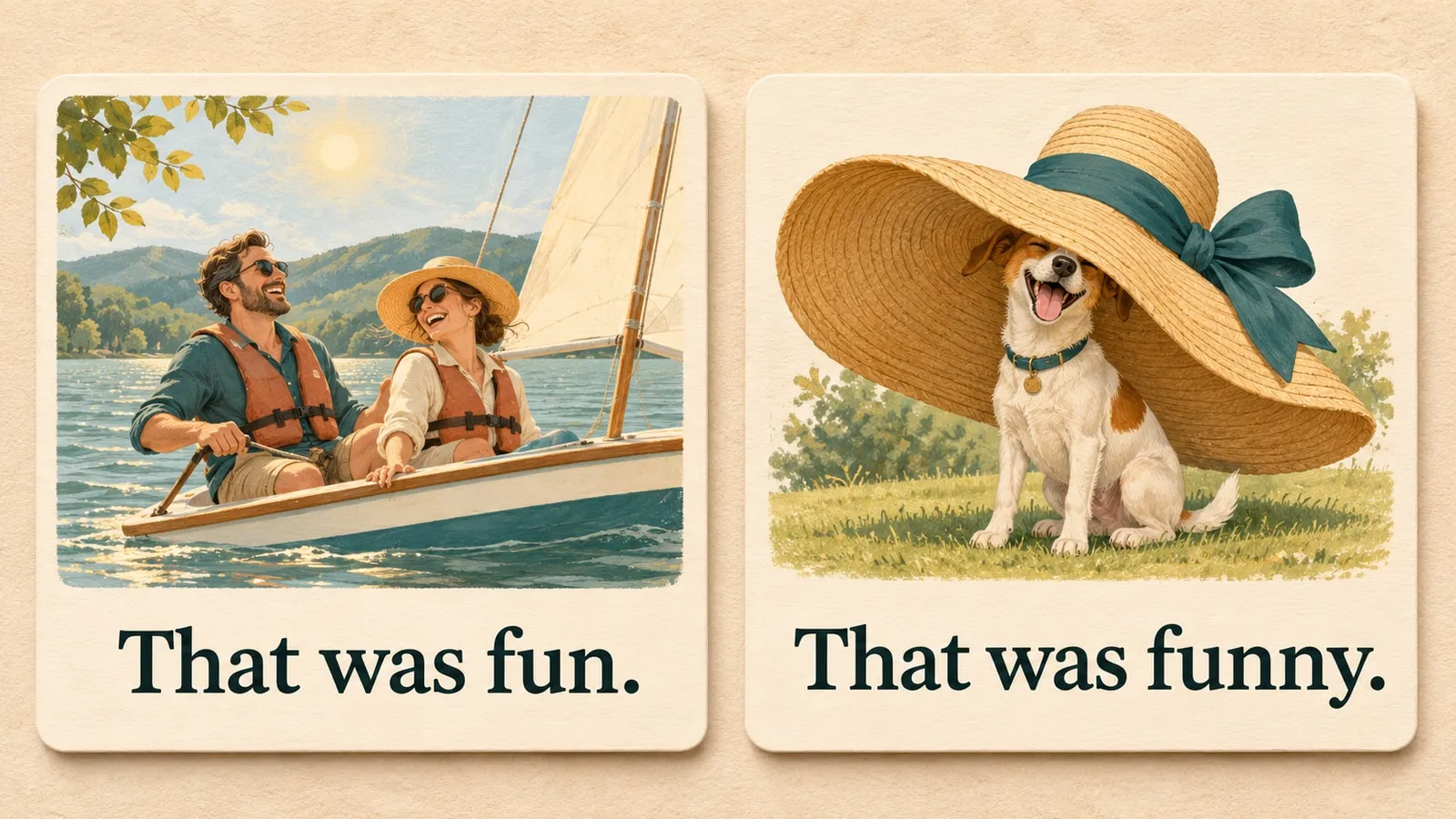
Fun means enjoyment or describes something enjoyable. Funny usually means amusing, but it can also mean strange. After a good day out, That was fun! praises the experience. That was funny! points to something that made you laugh or seemed unusual.
Choose the message first: did you enjoy something, laugh at it, or find it odd? The words can describe the same event without meaning the same thing.
The difference at a glance
| Your message | English expression | Example |
|---|---|---|
| We enjoyed ourselves. | have fun | We had fun at the lake. |
| An experience was enjoyable. | be fun | The boat trip was fun. |
| Something causes laughter. | funny | Her joke was funny. |
| Something seems strange. | funny | This milk smells funny. |
Cambridge English Grammar Today explains this distinction. An enjoyable experience does not have to involve humour.
Fun: enjoyment and enjoyable experiences
As a noun with this meaning, fun is uncountable. Learn these phrases as complete patterns:
- Have fun at the concert! — A wish that someone enjoys the event.
- We had a lot of fun. — We enjoyed ourselves very much.
- I paint for fun. — I paint for enjoyment.
- It was fun to try something new. — Trying it was enjoyable.
Say We had fun, not We had a fun. A lot of fun is correct: the article is part of a lot, not an article before a countable fun.
Is “a fun evening” wrong?
No. Fun is also used informally as an adjective, so We had a fun evening is possible. The article a belongs to evening. A rule saying that fun can never be an adjective would be misleading. An enjoyable evening is a more neutral alternative.
Also distinguish have fun from make fun of someone, meaning to mock them: Don’t make fun of his accent. The latter is not another way to say “enjoy yourself”.
Funny: amusing or strange
Funny often describes humour:
- That comedian is funny. — The comedian makes people laugh.
- She sent me a funny photo. — The photo was amusing.
It can also describe something unusual:
- My laptop is making a funny noise. — The noise seems strange.
- There’s a funny smell in the kitchen. — The smell is odd.
Context tells you which meaning applies. I feel funny often means that you feel odd or slightly unwell; it does not mean you are having fun.
Same event, different message
The film was fun says you enjoyed it. The film was funny highlights its humour. Both descriptions can be true of one film, but they make different points.
The distinction also works with people: Mia is fun to be with means you enjoy spending time with her. Mia is funny can mean she makes you laugh. In a different context, funny could describe her as strange.
Use this quick decision:
- Enjoyable experience? Fun.
- Humour or laughter? Funny.
- Odd or hard to explain? Often funny, too; strange makes that meaning clearer.
Pronunciation: one syllable or two
Fun is /fʌn/; funny is /ˈfʌn.i/. Funny has two syllables, with stress on the first. Neither starts with the vowel sound in fine /faɪn/. Say this pair aloud: a fun day — a funny story.
For more phrase-based listening practice, see learning a language with audio flashcards.
Ten fun and funny exercises
Choose the form for the stated meaning. Keep the other words unchanged.
- Wish someone an enjoyable time: Have ___ at the party! (fun / funny)
- Say you enjoyed the trip: We had a lot of ___. (fun / funny)
- The joke made everyone laugh: That joke was ___. (fun / funny)
- The milk smells strange: This milk smells ___. (fun / funny)
- You paint for enjoyment: I paint for ___. (fun / funny)
- Describe an enjoyable evening informally: We had a ___ evening. (fun / funs)
- Correct the sentence meaning “We enjoyed ourselves”: We had a fun.
- Ask someone not to mock her name: Don’t make fun ___ her name. (of / at)
- Emphasise the film’s humour: The film was ___. (fun / funny)
- Someone feels slightly unwell. Does I feel funny mean “I am enjoying myself” or “I feel odd” here?
Answers explained
- fun — The phrase is have fun.
- fun — A lot of fun describes plenty of enjoyment.
- funny — The intended meaning is humorous.
- funny — Here it means strange.
- fun — For fun means for enjoyment.
- fun — An informal adjective before evening; not a plural funs.
- We had fun. — Remove the indefinite article.
- of — Learn make fun of as a complete pattern.
- funny — Fun could describe an enjoyable film, but would not specifically highlight humour.
- I feel odd. — Funny describes feeling unwell in this context.
Practise complete phrases
Write down three situations on paper: an enjoyable trip, a good joke and a strange noise. Make an English sentence for each before checking the examples. Check the meaning separately from the phrase pattern, including have fun.
For your wider language routine, Lingo Phrase Cards lets you choose an offered language pair and a suitable set. Its prepared material presents words in phrases, with IPA and audio generated using Amazon Polly Neural for the target-language phrases. Answer before turning the card over, then assess your answer in the regular Leitner study mode. Categorised sets may require a licence.
Explore the available language pairs and sets in Lingo Phrase Cards.