Pedir vs preguntar: Spanish examples and ten exercises with answers
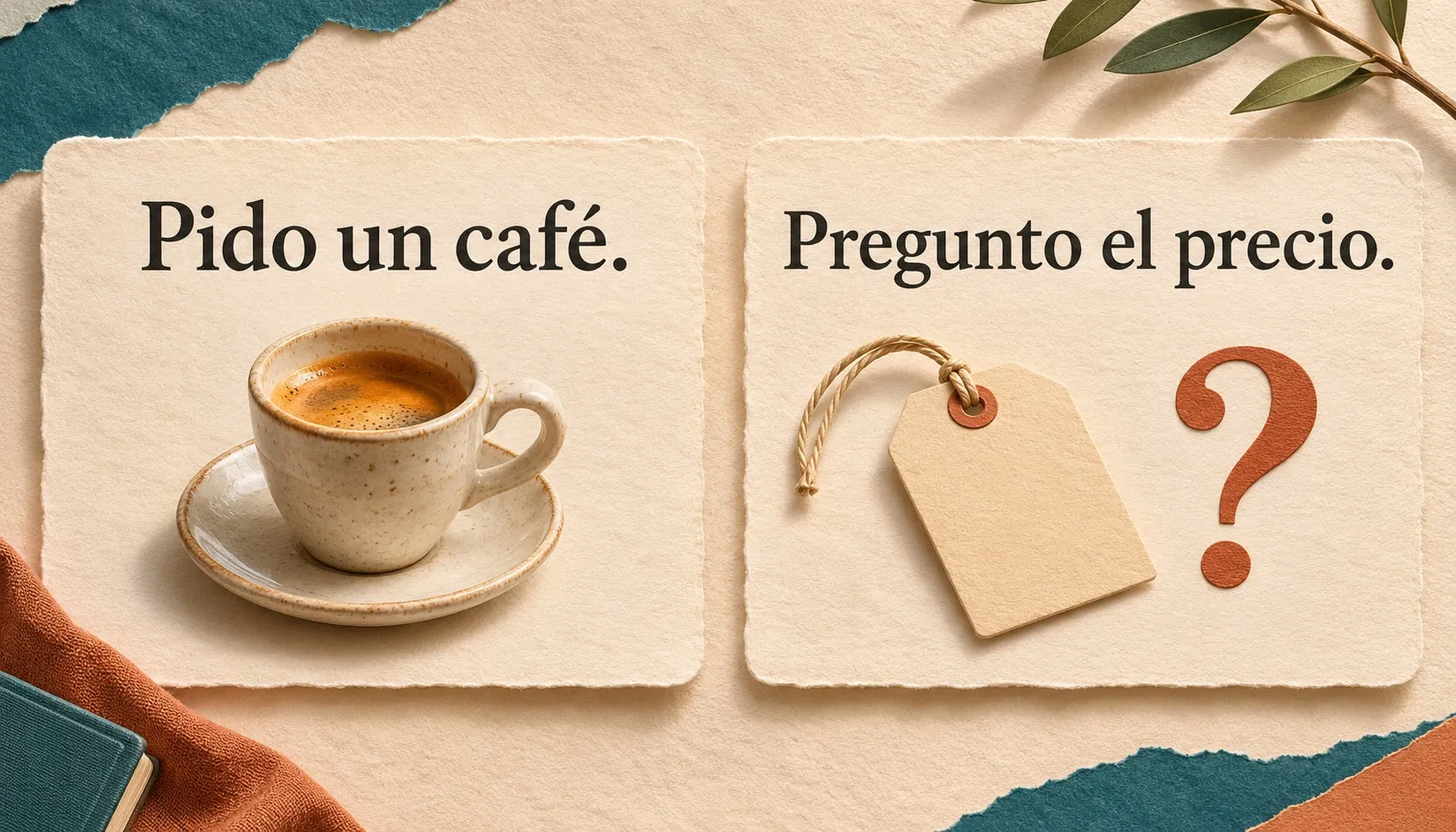
English uses ask for both asking for a coffee and asking its price. Spanish separates those actions: Pido un café means “I order a coffee”; Pregunto el precio means “I ask the price”. Use pedir for a request or order, and preguntar for a question.
Start with your intention: Do you want something provided or done, or do you want an answer? Then choose the sentence pattern. The ten exercises below let you practise both meaning and form.
The difference at a glance
| Your intention | Pattern | Example |
|---|---|---|
| Order or request something | pedir + thing | Pido un café. — I order a coffee. |
| Ask for help or permission | pedir + abstract noun | Pedimos ayuda. — We ask for help. |
| Ask for a specific fact | preguntar + question content | Pregunto el precio. — I ask the price. |
| Ask whether or when something happens | preguntar + si / question word | Pregunto si está abierto. — I ask whether it is open. |
| Enquire about a topic | preguntar por + topic | Pregunto por el horario. — I enquire about the opening hours. |
“A noun follows, so use pedir” is not a reliable shortcut. El precio is a noun too, but here it represents a question: “What is the price?”
Pedir: ask for something to be provided
Put what you request directly after pedir. Do not translate English for with an extra preposition:
- Quiero pedir la cuenta. — I want to ask for the bill.
- Necesitamos pedir permiso. — We need to ask for permission.
- Voy a pedir información en recepción. — I am going to request information at reception.
The last example also shows why “information always takes preguntar” is too broad. Pedir información presents a request for information; preguntar a qué hora abre el museo spells out the question you want answered.
Learn pedir ayuda, pedir permiso and pedir un favor as complete phrases. When ordering a coffee, say pedir un café, not pedir por un café. Pedir por has other uses, including prayer, but it is not a general equivalent of “ask for”.
Preguntar: state the question
Your question content can be a noun or a clause:
- Pregunto la hora. — I ask the time.
- Preguntamos dónde está la estación. — We ask where the station is.
- ¿Puedes preguntar si aceptan tarjetas? — Can you ask whether they accept cards?
Use si, without an accent, for an embedded yes/no question. Question words such as dónde, cuándo and qué keep their written accents in indirect questions: Pregunto cuándo empieza el curso — “I ask when the course starts.”
With preguntar por, you enquire about a topic: Pregunto por el horario. This differs from the direct request in Pido un café.
Who receives the request or question? Le and a
Both verbs let you name the person you address:
Le pido ayuda a Ana. — I ask Ana for help.
Le pregunto la hora a Ana. — I ask Ana the time.
Le and a Ana refer to the same recipient. What you request is ayuda; what you ask about is la hora. Ana is an indirect object in both sentences. To say “I ask her”, use le pregunto, not la pregunto.
For several recipients, use les: Les pido ayuda a mis compañeros — “I ask my colleagues for help.” For more on these roles, see the guide to lo, la and le.
Asking someone to do something: pedir que
A common pattern for requesting an action is pedir + que + subjunctive:
Le pido a Ana que cierre la puerta. — I ask Ana to close the door.
I make the request; Ana is to close the door. Cierre is a subjunctive form of cerrar. Use pido que, without de.
Compare Le pregunto a Ana si puede cerrar la puerta: “I ask Ana whether she can close the door.” In conversation, that question can also function as a polite request. When reporting it, preguntar si describes the question, while pedir que describes the requested action.
Present tense: pido, but pedimos
| Person | pedir | preguntar |
|---|---|---|
| yo | pido | pregunto |
| tú | pides | preguntas |
| él / ella / usted | pide | pregunta |
| nosotros / nosotras | pedimos | preguntamos |
| vosotros / vosotras | pedís | preguntáis |
| ellos / ellas / ustedes | piden | preguntan |
In the present tense, pedir changes e to i in its stressed stem forms: pido, but pedimos and pedís. Preguntar follows the regular -ar pattern. Vosotros is the familiar plural form in much of Spain; Latin American Spanish uses ustedes with piden/preguntan. The table gives tú forms and does not include regional vos forms.
Ten exercises: answer before checking
For 1–6, use the present tense of pedir or preguntar. Follow the meaning cue. For 7–8, use the infinitive.
- Yo ___ un café al camarero. (I am ordering a drink.)
- ¿Tú ___ cuándo empieza la visita? (You want to find out the starting time.)
- Nosotros ___ ayuda para mover esta mesa. (We are requesting assistance.)
- Ella ___ el precio de la entrada. (She asks how much the ticket costs.)
- Ustedes ___ permiso para entrar. (You are requesting permission.)
- Yo le ___ a Ana si el museo abre hoy. (I want a piece of information.)
- Quiero ___ la cuenta. (I want the bill brought to me.)
- Vamos a ___ por el horario. (We are enquiring about the opening hours.)
- Replace the incorrect verb form: Yo pedo un favor.
- Complete the request with the appropriate form of cerrar: Le pido a Ana que ___ la puerta.
Answers explained
- pido — an order; the irregular yo form of pedir.
- preguntas — cuándo introduces the starting time you want to learn.
- pedimos — a request for help; nosotros keeps the e in the stem.
- pregunta — el precio represents the question about the price.
- piden — permission is requested; ustedes takes this plural form.
- pregunto — si introduces an information question; le refers to Ana.
- pedir — the bill is to be provided; quiero is followed by the infinitive here.
- preguntar — preguntar por el horario means to enquire about the hours.
- Yo pido un favor. — The correct form is pido, not pedo.
- cierre — a request addressed to Ana, with que and the subjunctive: que cierre.
Two sentences for your next café visit
Write an order and an information question, such as Pido un café and Pregunto cuánto cuesta — “I order a coffee” and “I ask how much it costs”. Hide the Spanish and reconstruct each sentence from its purpose. Then change just one part: un café → un té or cuánto cuesta → si tienen leche.
For more situations, explore the guide to everyday Spanish vocabulary.
In Lingo Phrase Cards, you can choose an offered language direction and a suitable set. The prepared target-language phrases include IPA transcription and audio. In regular study, answer before turning the card over, then assess your recall: that assessment changes its box and due date. Extra practice with mistake cards lets you go through them without changing card progress. Some categorised sets require a licence.
Visit the Lingo page to explore the available language directions and sets for your next short study session.
Sources and further reading
- RAE / ASALE, in Spanish: pedir in the Diccionario panhispánico de dudas, preguntar and pedir conjugation model.
- Lelivrescolaire.fr, in French: Pedir et Preguntar.