Lo, la or le? Spanish object pronouns with examples and exercises
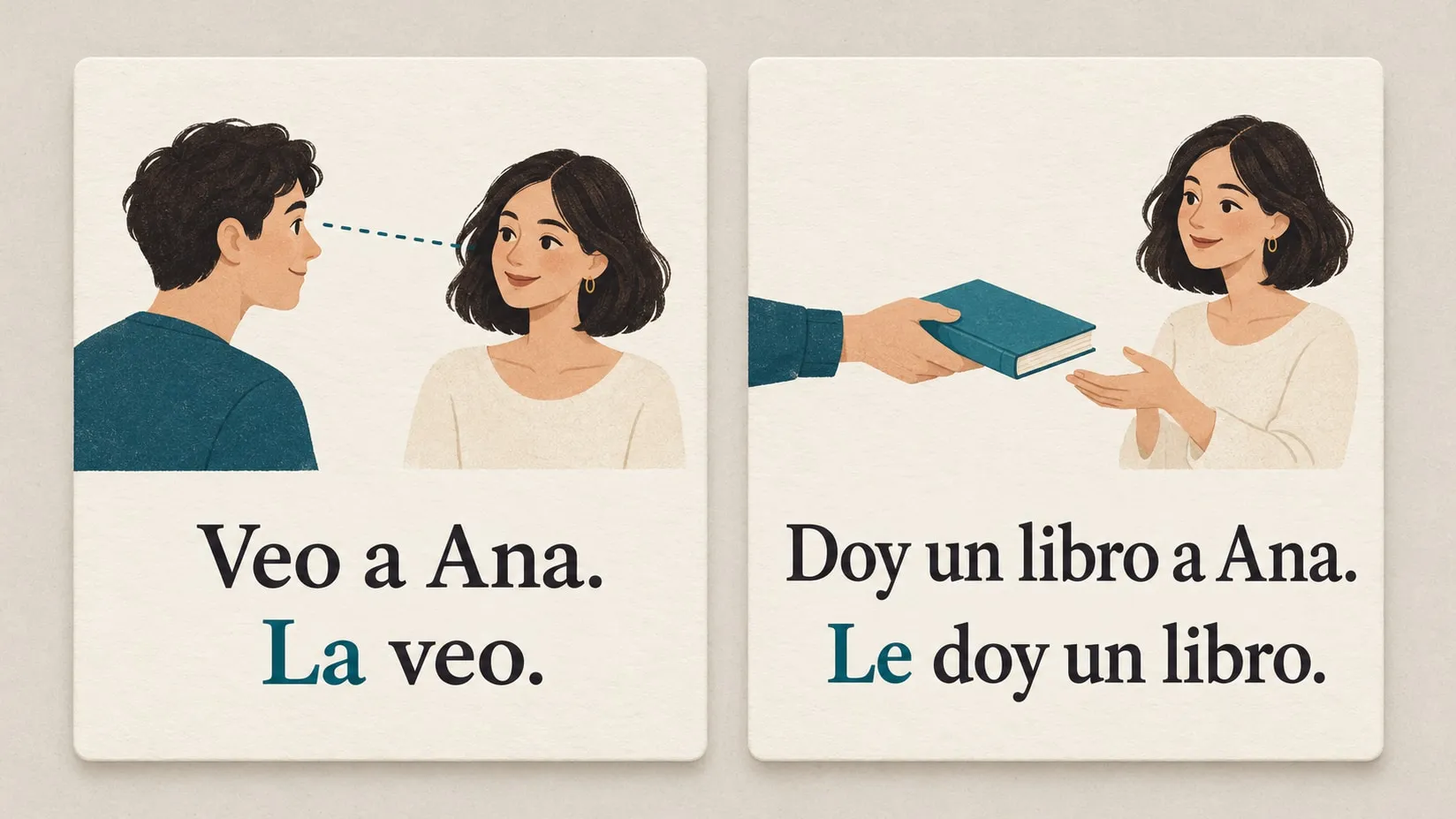
Veo a Ana. → La veo. I see Ana. → I see her. Doy un libro a Ana. → Le doy un libro. I give Ana a book. → I give her a book. Both sentences refer to the same woman, but one needs la and the other le. Her role in the Spanish sentence makes the difference.
This guide explains direct and indirect object pronouns, where to place them, and why le + lo becomes se lo. Eight exercises with explanations let you put the distinction into practice.
Start with the verb and the object’s role
A direct object completes a verb such as ver (see), leer (read) or comprar (buy). In Veo a Ana, Ana is the person being seen. In Leo el libro, the book is what is being read.
An indirect object identifies the recipient with verbs such as dar (give) or enviar (send). In Doy un libro a Ana, un libro is the direct object and a Ana is the indirect object.
Use this sequence:
- Identify the Spanish verb pattern: ver a alguien, dar algo a alguien.
- Decide which part of the sentence you want to replace.
- Choose the pronoun by role and number; direct object pronouns also depend on Spanish grammatical gender.
English her cannot decide the answer for you: “I see her” and “I give her a book” use the same English form. Spanish distinguishes La veo from Le doy un libro. Learn the Spanish construction rather than matching individual translated words.
Lo, la, los, las versus le and les
The basic third-person system distinguishes these functions:
| Role | Singular | Plural | Example |
|---|---|---|---|
| direct, masculine | lo | los | Leo el libro. → Lo leo. |
| direct, feminine | la | las | Leo las cartas. → Las leo. |
| indirect, either gender | le | les | Doy un libro a Ana. → Le doy un libro. |
Le can refer to a male or female recipient; les refers to plural recipients. Their gender does not change the pronoun. With lo/la, follow the Spanish noun: el libro → lo, la carta → la. English “it” does not reveal that distinction.
The other unstressed object pronouns are me, te, nos, os, which can be direct or indirect. Here we focus on the third person. Spanish also has neuter lo, as in No lo entiendo referring to a previous statement. Not every lo replaces a masculine noun.
Personal a does not mean indirect object
Spanish often puts personal a before a specific person who is the direct object:
- Veo a Ana. → La veo. I see her.
- Veo a Pablo. → Lo veo. I see him.
- Invito a mis amigas. → Las invito. I invite them.
The a does not turn these people into indirect objects. Compare the roles:
- Veo a Ana. Ana is being seen: direct → la.
- Doy un libro a Ana. Ana receives the book: indirect → le.
You can also keep the recipient’s name: Le doy un libro a Ana. Or put it first: A Ana le doy un libro. An indirect object pronoun and an explicit recipient can appear together.
Where do Spanish object pronouns go?
In an ordinary statement, the unstressed pronoun comes before the conjugated verb. In compound tenses, it goes before haber, not on the past participle:
- La veo. I see her.
- No la veo. I don’t see her.
- La he visto. I have seen her.
With constructions such as ir a + infinitive, two positions are possible:
- Lo voy a comprar.
- Voy a comprarlo.
Both mean “I’m going to buy it”. When attached, the infinitive and pronoun form one written word. Likewise, La estoy leyendo and Estoy leyéndola both mean “I’m reading it”; the written accent preserves the stress.
With an affirmative tú-command, attach the pronoun: Cómpralo, buy it. With a negative command, put it before the verb: No lo compres, don’t buy it. Learn the whole form rather than treating placement as a free choice.
Two pronouns: why se lo instead of le lo?
Start with Doy el libro a Ana. Replacing Ana gives Le doy el libro. Replace the book as well, and le + lo would meet. Before lo, la, los, las, however, le/les changes to se:
Le doy el libro. → Se lo doy. I give it to her.
The order is still indirect before direct:
- Envío la foto a Ana. → Se la envío. I send it to her.
- Doy los libros a Ana. → Se los doy. I give them to her.
- Doy el libro a Ana y Pablo. → Se lo doy. I give it to them.
Here se does not tell you whether there is one recipient or several. Lo/los follows the book or books, not the number of recipients. Add a ella or a ellos if clarification is useful.
Keep both pronouns together: Se lo voy a dar or Voy a dárselo. Do not put one before the conjugated verb and attach the other to the infinitive.
Why do some speakers say le veo?
Especially in parts of Spain, you may hear Le veo for a man who is a direct object. This is called leísmo. The current RAE/ASALE account accepts le/les for masculine people as direct objects; the singular is particularly common. Other regional and construction-specific patterns also exist.
The exercises below consistently use lo/la/los/las for direct objects and le/les for indirect objects. This keeps the functional distinction clear while you build your foundation.
Eight exercises
Replace the specified part or supply the pronoun. Try answering before reading the key.
- Leo el mensaje. Replace el mensaje.
- Veo a Ana. Replace a Ana.
- Doy una llave a Pablo. Replace only a Pablo.
- Envío una foto a mis amigas. Replace only a mis amigas.
- Compro las entradas. Replace las entradas.
- Le doy la llave. Replace la llave as well.
- Voy a comprar el libro. Give both possible pronoun positions.
- Compra el libro. / No compres el libro. Replace el libro in each command.
Answers and explanations
- Lo leo. El mensaje is masculine singular and a direct object.
- La veo. Ana is a direct object despite personal a.
- Le doy una llave. Pablo is the recipient; una llave remains the direct object.
- Les envío una foto. There are several recipients, so use les, not las.
- Las compro. Las entradas is a feminine plural direct object.
- Se la doy. La replaces la llave, and le becomes se before it.
- Lo voy a comprar. / Voy a comprarlo. Before the verb group or attached to the infinitive.
- Cómpralo. / No lo compres. Attach in the affirmative; place before the negative command.
Practise a short chain of complete sentences
Write three versions of an everyday sentence: Doy el libro a Ana → Le doy el libro → Se lo doy. Say them aloud and explain each pronoun: who receives something, and what is being given? Then change just one element, such as el libro to los libros. The change from se lo to se los now has a clear reason.
In Lingo Phrase Cards, you can choose an available Spanish language direction and set to study ready-made phrases. Target-language phrases include IPA and audio generated with Amazon Polly Neural. Use the pronunciation support and try recalling the complete expression before turning the card. The sentences in this article are independently written practice examples.
Regular learning updates Leitner boxes and due dates. Free incorrect-card practice lets you go through difficult cards without changing their progress. Continue with Spanish vocabulary in everyday sentences or another meaning-based choice, por versus para.
Explore the available language directions and sets in Lingo Phrase Cards. Categorised sets may require a licence.
Sources and further reading
- RAE/ASALE: Pronombres personales átonos — forms, placement and combinations.
- RAE/ASALE: Leísmo — variation and regional context.
- Lingolia: Spanish personal pronouns — further explanations of direct and indirect objects.