Look, see or watch? The difference and ten exercises with answers
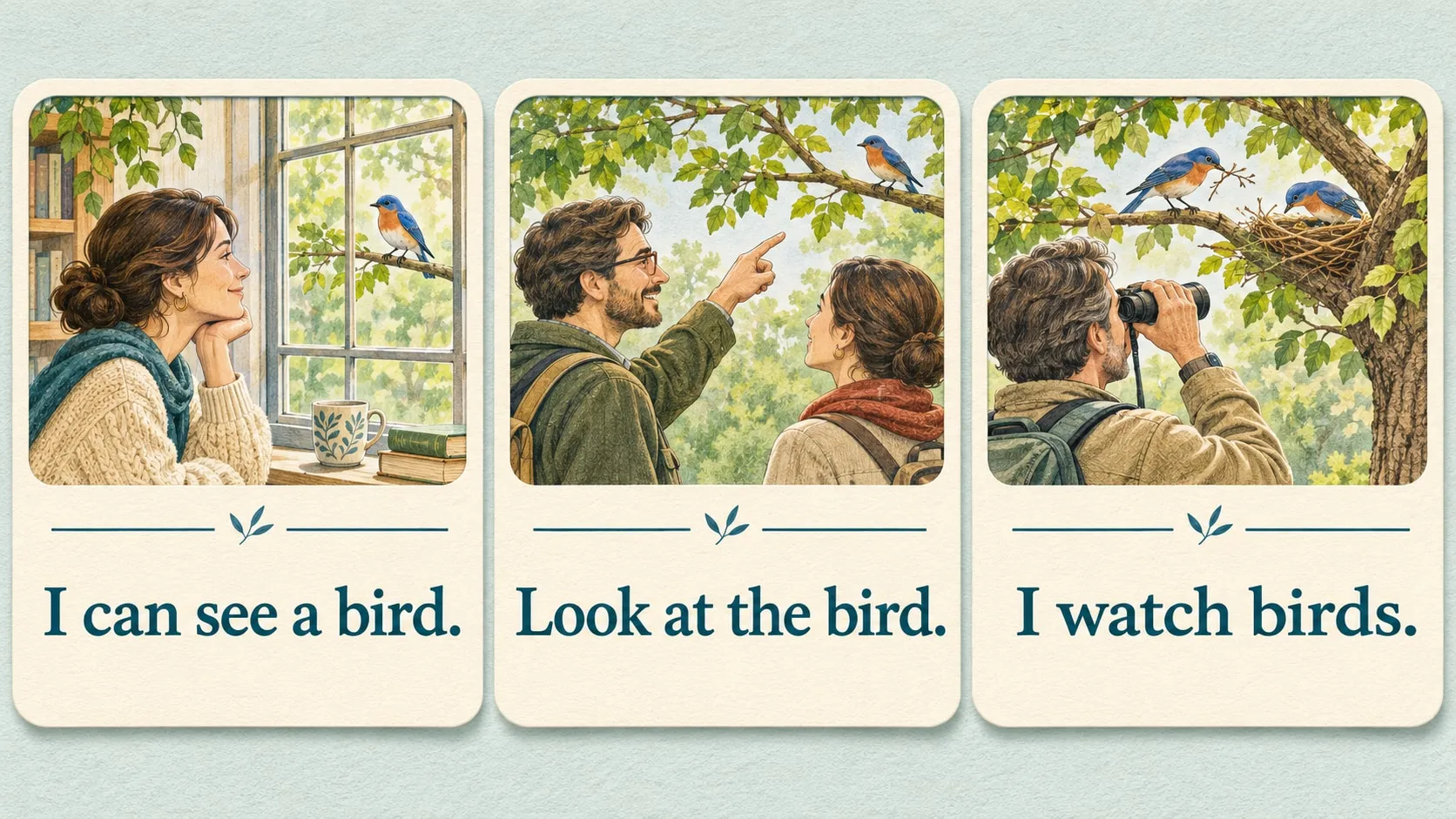
See describes what you notice with your eyes. Look at means to direct your eyes towards something. Watch means to follow something with your attention for a period of time, often as it moves or changes. All three involve your eyes, but they present different parts of the experience.
Compare I can see a bird, Look at the bird and I watch birds. The bird stays the same; the speaker’s meaning changes. Choose the message before choosing the verb.
The three patterns at a glance
| Your message | Pattern | Example |
|---|---|---|
| Something is visible to you | see + object | I can see the station. |
| You direct your eyes towards it | look at + object | Look at the map. |
| You follow an unfolding activity | watch + object | We watch the birds building a nest. |
Cambridge English Grammar Today explains this basic distinction. It is a guide to meaning, not a rule assigning one verb to each object.
See: what do you notice?
With see, the visual experience is central. You do not have to decide to pay attention first:
- I can see a bird in the tree.
- Did you see the red car?
- I can’t see the screen from here.
For ordinary perception happening now, can see is common. I’m seeing a bird is not the usual way to express that meaning. However, seeing is possible with other meanings: I’m seeing Anna tomorrow can describe an arrangement to meet. I see what you mean means that you understand, rather than literally see something.
Look at: where do you direct your eyes?
Learn look at as a complete pattern when you mean directing your attention visually towards a person or thing:
- Look at the bird.
- She’s looking at a photo.
- Please look at me.
Change look the photo to look at the photo. With no object, Look! can stand alone.
This does not mean that at follows every use of look. Look for your keys means search for them. You look tired describes appearance and takes an adjective. For that pattern, see adjectives and adverbs.
Watch: what activity do you follow?
Watch puts the focus on paying attention over time. The thing you observe is often moving or changing:
- I watch birds in the garden.
- We’re watching the children play.
- She watches TV after dinner.
The everyday expression is watch TV, without at. Look at the TV directs someone’s eyes towards the set; it does not necessarily mean watching a programme. I can see the TV simply says that the television is visible.
Can more than one verb work?
Yes. I saw the birds building a nest reports a visual experience. I watched the birds building a nest highlights spending time following the activity. Movement alone does not force you to choose watch.
Both watch a film and see a film are used. For a cinema visit, We went to see a film is a common expression. We watched a film at home naturally describes the viewing activity. Learn these phrases in context rather than treating watch as universally impossible at a cinema.
See, saw and seen
| Base form | he/she/it | Past simple | Past participle |
|---|---|---|---|
| see | sees | saw | seen |
| look | looks | looked | looked |
| watch | watches | watched | watched |
Say Yesterday I saw a fox, but I’ve seen that fox before. After did/didn’t, use the base form: Did you see it?, not Did you saw it? Also notice she watches, not she watchs. Review questions with do, does and did if you need more practice with that structure.
Ten look, see and watch exercises
Choose from the options. Keep the other words unchanged. Where a meaning is specified, choose the form that expresses it.
- The tree is visible from your position: I can ___ the tree from here. (see / look)
- Please ___ at the map before we leave. (look / watch)
- Describe the habit of watching television: We ___ TV every evening. (watch / look)
- I looked ___ the photo on her desk. (at / —)
- Describe ordinary visual perception now: I ___ a bird. (can see / am seeing)
- Yesterday, I ___ a fox near the station. (saw / seen)
- Have you ___ my glasses? (saw / seen)
- Did you ___ the bird? (see / saw)
- She ___ TV after dinner. (watchs / watches)
- Emphasise following the activity over time: We ___ the birds building their nest for half an hour. (watched / saw)
Answers explained
- see — The message is visibility, not directing your eyes.
- look — The existing at gives you look at the map.
- watch — The expression is watch TV.
- at — Use look at the photo.
- can see — The usual pattern for visual perception at this moment.
- saw — The past simple of see.
- seen — This present perfect question needs the past participle after have.
- see — Use the base form after did.
- watches — Add -es with she.
- watched — The requested focus is spending time following the process. Saw can report a visual experience in another context, but does not give it the same emphasis.
Practise complete phrases
Write three situations on paper: something is visible, you ask someone to direct their eyes towards something, and you observe an activity. Say a complete sentence for each before checking the examples. Then check the verb, at and tense separately. For the equivalent listening question, try the hear and listen exercises.
For your wider language routine, Lingo Phrase Cards lets you choose an offered language pair and a suitable set. Its prepared content presents words in phrases, with IPA and audio generated using Amazon Polly Neural for the target-language phrases. Answer before turning the card over, then assess your answer in the regular Leitner study mode to schedule later reviews. Categorised sets may require a licence.
Explore the available language pairs and sets in Lingo Phrase Cards.
Sources
- Cambridge: Look at, see or watch?
- Lingolia: watch, look, see — German-language explanation
- Englisch-hilfen: look, see or watch — German-language explanation