Make a telling-time pairs game with clock and number cards
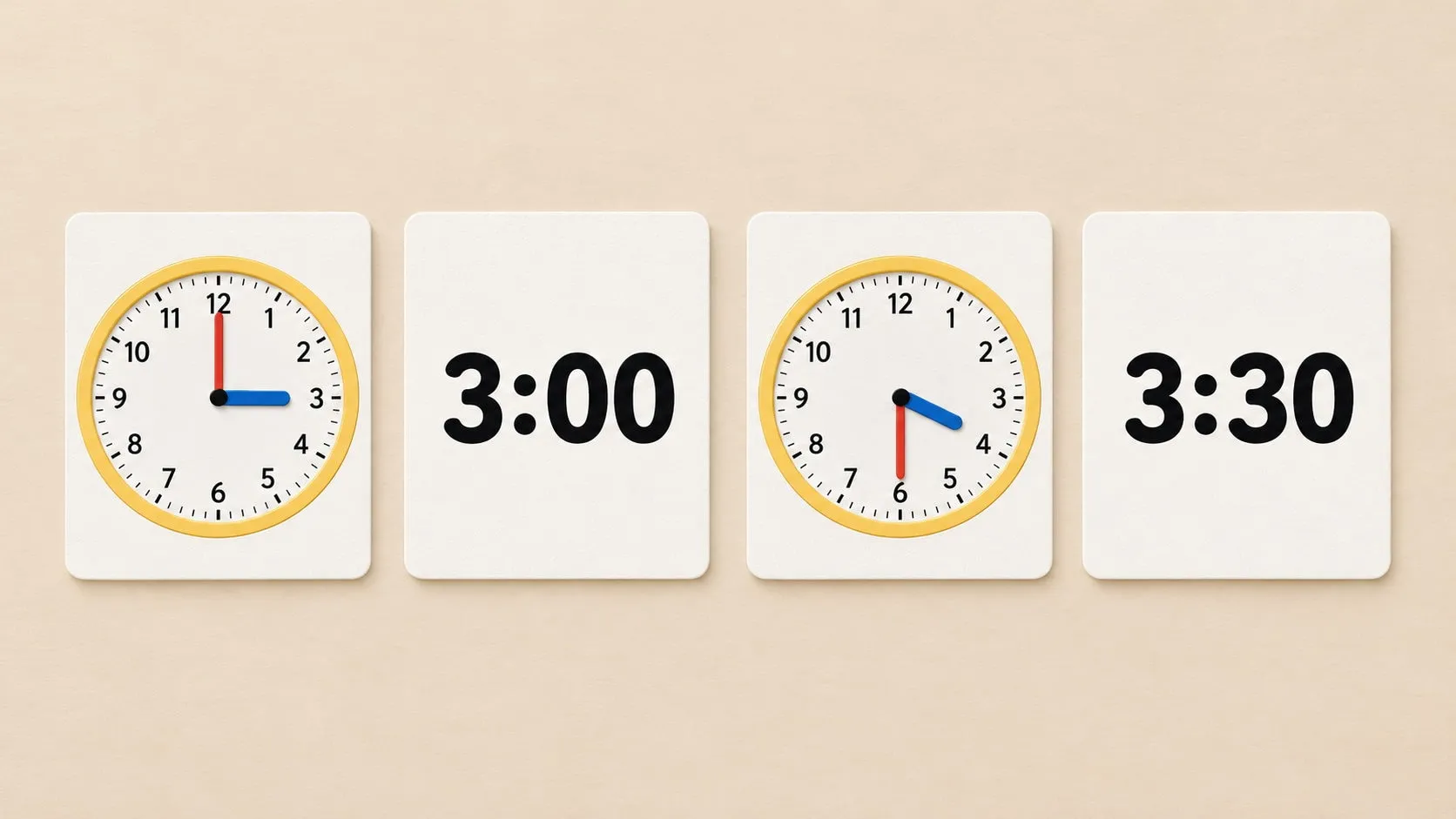
One card shows an analogue clock; another says 3:30. Do they belong together? In this homemade pairs game, you match a hand position to a numerical time and explain why it fits. Six pairs make a manageable activity for a child and an adult, or for two learners playing together.
Below are the materials, all six pairs and two ways to play: match the cards face up first, then try a face-down memory round if you wish. Make the cards on paper; an adjustable clock can help you check the drawings.
Prepare twelve cards
You need stiff paper or card, a pencil, ruler, scissors and two coloured pens. A round object helps you draw the clock faces. Cut out twelve cards of the same size. Their backs should look identical, so they give no clues about the card type or time.
Draw a clock face numbered 1 to 12 on six cards. Place 12 at the top, 3 on the right, 6 at the bottom and 9 on the left, then space the other numbers between them. Mark the centre. Draw a short hour hand and a long minute hand. You might colour the short hand blue and the long hand red; keep the colours consistent on every clock.
Write one numerical time from the table on each remaining card. Do not also write the numerical answer on the clock card. That would let a player find the pair without reading the hands. Matching coloured borders or little symbols would give the answer away too, so use the same design throughout.
Six pairs and the correct hand positions
Every time falls between three and four o’clock. This lets you compare how the two hands move through one hour. Turn each row into one clock card and one number card.
| Number card | Long minute hand | Short hour hand |
|---|---|---|
| 3:00 | on 12 | exactly on 3 |
| 3:30 | on 6 | halfway between 3 and 4 |
| 3:15 | on 3 | a quarter of the way from 3 to 4 |
| 3:45 | on 9 | three quarters of the way from 3 to 4 |
| 3:20 | on 4 | a third of the way from 3 to 4 |
| 3:55 | on 11 | almost at 4, but not there yet |
The hour hand does not stay on 3 for the whole hour. At 3:55 it has travelled eleven twelfths of the way towards 4. It reaches 4 at 4:00, when the minute hand returns to 12.
Check the drawings against the table before playing. Look for correctly ordered numbers, clearly different hand lengths and the positions of both hands. If the minute values need a refresher, see our guide to reading an analogue clock in five-minute steps.
Round one: match face up and explain
Start with just 3:00 and 3:30 and their clock cards. Put all four cards face up in a mixed order. One person chooses a clock, finds the number card and explains:
“The long hand is on 6, which means 30 minutes. The short hand is between 3 and 4. This clock matches 3:30.”
The other person checks both hands using the table. Swap roles. Once the matching makes sense, add 3:15 and 3:45, then introduce the last two pairs later.
If a match is wrong, ask “Which hour has started?” and “How many minutes does the long hand show?” When the short hand is just before 4, four o’clock has not arrived yet: the answer is 3:55, not 4:55. You do not need a timer or a fixed number of rounds.
Round two: find pairs face down
Use only the pairs you have already discussed face up. Make sure each clock has exactly one matching number card. Shuffle them and lay them face down.
- One player turns over two cards.
- If they show a clock and its matching time, the player explains both hands and keeps the pair. They take another turn.
- If the cards do not match, or both are clocks or both are number cards, leave them visible briefly. Turn them back over and let the other player have a turn.
- Continue until all pairs are found. Count the pairs at the end if you like, or collect them together as a team.
If an explanation is uncertain, leave the cards face up and consult the table together. Understanding the connection between the clock and the numbers comes first; remembering the card positions is an extra part of this version.
Adjust the game to suit you
- Simpler: use two pairs face up, starting with the hour and half hour.
- Without memory: lay all clock cards on the left and number cards on the right, face up. Take turns choosing and explaining a pair.
- A closer comparison: place 3:15 and 3:20 side by side. What changes on the long hand, and on the short one?
- More pairs later: make cards from another hour. Check both hands first and avoid duplicate number cards.
These cards deliberately use twelve-hour times. Deciding whether the time is in the morning or afternoon is not an extra task in this round.
Use a practice clock to compare
In the UhrenABC / ClockABC web application, open the free practice clock, labelled “Zeit üben” in the German interface. Set a card’s time using the hour and minute sliders. The analogue hands, digital displays and written time update together. Compare your 3:30 drawing with the screen: is the short hand really halfway between 3 and 4?
The free clock does not automatically mark your paper cards; you check the match together. The pairs game itself takes place with your cards on the table.
Begin with two pairs, explain both hands and then add more times. You can find the application links on the UhrenABC website.